
Nobody in the stadium breathes during a penalty kick. The whole game stops. Tens of thousands of people watch one player walk up to a spot twelve yards from goal. What most of them do not know is just how many rules sit behind that single moment.
Get any part of it wrong and the kick gets retaken, disallowed, or reversed entirely. This guide walks through all of it plainly.
What Foul Gives a Penalty?
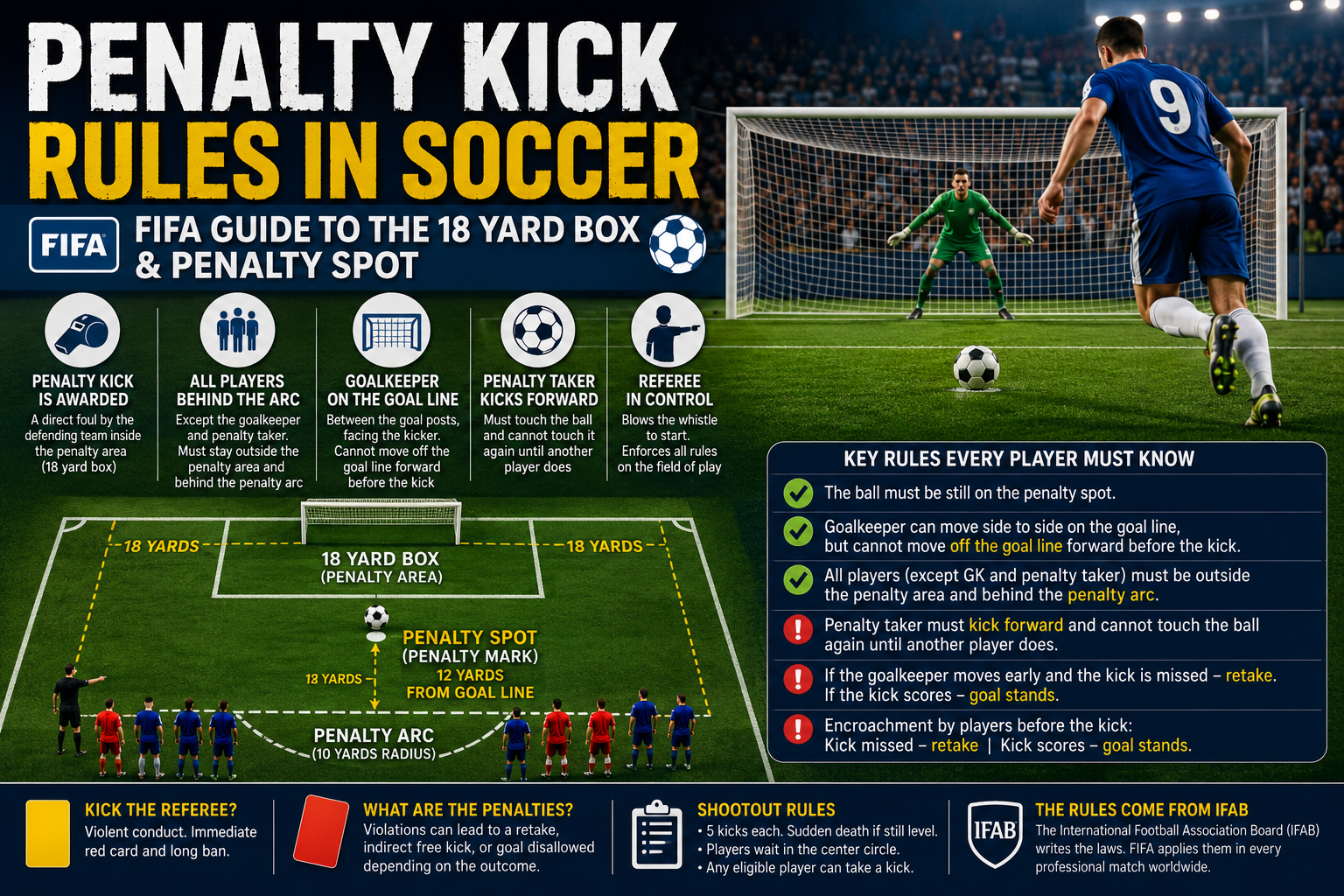
So when exactly is a penalty kick awarded? It happens the second a player from the defending team commits a direct foul on an opponent inside their own penalty area. Players everywhere call that space the 18 yard box soccer coaches diagram on whiteboards before every big match. It runs 18 yards from the goal line and stretches past each of the goal posts on both sides.
Here is what sends the referee pointing at the penalty mark:
- Deliberately handling the ball inside the penalty area
- Pushing, tripping, or holding an attacker inside the box
- Going in late and making contact with the player before they touch the ball
- Barging into an opponent without going for the ball at all
The moment any of these happen inside the box a direct free kick is awarded from the penalty spot. Not from the foul location. Always that same painted spot twelve yards out. The football association board IFAB writes every law covering this and the international football association board applies those laws globally through FIFA.
The Penalty Spot and Penalty Arc
The penalty mark sits exactly 12 yards from the center of the goal line. That answers the common question of how far is a soccer penalty kick. Twelve yards. Same on every full-size pitch anywhere in the world.
That painted circle on the field of play is where everything begins. The ball must sit on it completely still before anything happens.
Just outside the top of the penalty area sits a curved line called the penalty arc. It marks ten yards from the penalty spot in every direction. Every player except the goalkeeper and penalty taker must stand outside the penalty area and behind that arc before the kick happens. Stepping past it early is a violation with real consequences depending on the outcome.
What Actually Happens During the Kick
Right. Here is where people get fuzzy on the details. A lot goes on in those few seconds and the penalty kick rules in soccer cover every bit of it.
- The ball goes on the penalty mark. Has to be still. Goalkeeper gets on the goal line between the goal posts facing the kicker. Every other player stands behind the penalty arc outside the penalty area. Referee blows the whistle.
- Now here is the part that trips people up. The goalkeeper cannot move forward before the penalty taker makes contact. They can shift left and right along the line but the moment a goalkeeper moves off the goal line toward the ball before it is kicked, a violation has occurred. If the shot misses after that, the kick is retaken.
- The penalty taker runs up and must kick the ball forward. That is it. No stopping and rolling it sideways to a teammate. Once they kick the ball they cannot touch the ball again until at least one other player makes contact with it first. Break that and it does not matter if the ball scores a goal, it gets ruled out.
- If the goalkeeper moves off the goal line early but the penalty taker still scores a goal, the goal stands. The retake only kicks in when the shot actually misses following that early movement
What Are the Penalties in Soccer When Rules Break Down?
What are the penalties in soccer when someone gets the procedure wrong mid-kick? Depends entirely on who did it and what the ball did afterward.
Penalty taker breaks a rule and the ball goes in and scores a goal, goal is disallowed, indirect free kick to the defending team. Penalty taker breaks a rule and misses — retake.
Teammate of the penalty taker sneaks past the penalty arc early and the kick misses retake. Same player encroaches and the kick goes in goal stands.
Player from the defending team enters early and the kick misses — retake. Defending player encroaches and the goalkeeper saves it retake.
Whatever happens to the ball after the violation determines what comes next. That is the pattern behind every decision.
Rules for Penalty Kicks in Soccer in Shootouts
Rules for penalty kicks in soccer during shootouts follow the same framework as during normal time. Five kicks each. Still level after all ten? Sudden death. One team scores, the other misses, it is over.
A few things work differently here:
- Players not shooting must wait inside the center circle until each kick is taken
- Goalkeepers can be swapped in for the shootout even if substitutions are fully used, depending on competition rules
- Any eligible player on the squad list can step up and kick the ball, not just outfield regulars
Things Players Keep Getting Wrong
The soccer penalty kick rules FIFA enforces get misread surprisingly often. Here is what causes the most confusion:
- Goalkeepers can move sideways along the goal line freely. They just cannot step forward before the kicker makes contact
- Once the ball rebounds off the post or the goalkeeper makes a save, it is live. Anyone can follow it up except the original penalty taker who cannot touch the ball again until someone else does first
- Feinting in the run-up is completely legal until the kicking motion commits fully. Stopping dead at the very last step once that motion starts is a violation
- Most violations lead to a retake not a turnover. Fouling during a penalty rarely hands the ball straight to the other side
Worth mentioning here: any attempt to physically kick the referee is treated as violent conduct, resulting in immediate dismissal and a significant ban. It almost never happens in real matches but it comes up in disciplinary discussions regularly enough to be worth knowing.
Conclusion
Every second of a penalty kick sits inside a rulebook most spectators have never read. Where players must stand. What the goalkeeper can do before the ball moves. What happens when someone steps too early or touches the ball at the wrong moment. All of it comes from the international football association board and gets applied by FIFA in every professional match on earth.
Once you understand the penalty kick rules in soccer properly the moment looks completely different. You watch the goalkeeper’s feet. You check where outfield players line up. You understand why a kick sometimes gets retaken when it looked perfectly clean from the stands.
The rules for penalty kicks in soccer and the soccer penalty kick rules FIFA puts in place exist for one reason. To give both sides a genuinely fair shot at the most pressurized moment the game ever produces.
FAQs
My teammate scored the rebound after my saved penalty. Does it count?
Yes. Once the save happens or the ball hits the post it is live. Anyone except the original penalty taker can follow it up. Just do not touch the ball yourself until someone else has.
The goalkeeper moved early but the kick went in. Is it still a goal?
Yes. If the ball crosses the line the goal stands even when the goalkeeper moves off the goal line early. The retake only applies when the kick misses following that movement.
Can the penalty taker fake their run-up to fool the goalkeeper?
Up to a point. Stuttering and slowing mid-approach is fine. Stopping completely once the final kicking motion has started is a violation and costs your team the kick.
What if the ball rolls off the spot before anyone kicks it?
Referee stops everything and resets it. The ball must be completely still on the penalty mark before the kick happens.
Does it matter which foot the penalty taker uses?
Not at all. No rule covers which foot kicks the ball. Players use whichever they prefer.
Can a substitute who just came on take a penalty in a shootout?
Yes as long as they are on the field and eligible. Any active player can step up during a shootout regardless of when they came on.