
Goalkeepers do not move like regular soccer players.
A striker may run forward for long distances. A midfielder may keep moving around the pitch. But a goalkeeper has to react in short, sharp bursts. One second you are set in position. The next second you are diving low, jumping high, pushing off one leg, or moving across the goal as fast as possible.
That is why plyometric exercises for goalkeepers are so useful.
Plyometrics train your body to produce power quickly. It is not only about being strong. It is about using that strength fast. For a goalkeeper, that can mean a stronger dive, a quicker first step, a higher jump, or a faster recovery after making a save.
Good plyometrics for goalkeepers should feel close to real goalkeeping movements. You want drills that improve jumping, landing, side-to-side movement, balance, core control, and quick reactions. When these exercises are done properly, they can help you move with more power and confidence in the goal.
Why Goalkeepers Need Plyometric Training
Goalkeeping is full of explosive movements.
You push off your foot to dive. You jump to claim crosses. You react to shots from close range. You shuffle across the goal. You come off your line quickly in 1v1 moments. These actions happen fast, and you do not get much time to think.
This is where plyometric training for goalkeepers helps.
Plyometric exercises train the muscles and nervous system to work together. The body learns how to stretch, load, and contract quickly. That quick loading action helps create more power in less time.
Think of it like a spring.
When you bend your knees before jumping, your body stores energy. Then you push off and release that energy. Plyometrics train that action again and again, so your body becomes better at explosive movement.
For soccer goalkeepers, this can help with:
- Stronger push-offs when diving.
- Faster lateral movement across the goal.
- Better jumping power for crosses and high shots.
- Quicker recovery after landing.
- Improved short-distance acceleration.
- More control when changing direction.
Research on soccer players has also linked plyometric work with better explosive strength, acceleration, and kicking power. For goalkeepers, those benefits matter because a save often depends on one quick step, one strong push, or one sharp reaction.
Start With A Proper Plyometric Warm-Up
Before doing any jumping drills, your body needs to be ready. A good plyometric warm-up for goalkeepers should increase blood flow, wake up the legs, and prepare the joints for fast movement.
Do not jump straight into tuck jumps or lateral bounds when your body is cold. That can increase stress on your ankles, knees, hips, and lower back.
Try this simple warm-up first:
| Warm-Up Drill | Time / Reps | Why It Helps |
| Light Jog | 3 minutes | Raises body temperature |
| High Knees | 2 x 20 seconds | Prepares the hips and legs |
| Side Shuffles | 2 x 20 seconds | Warms up lateral movement |
| Walking Lunges | 2 x 10 reps | Opens hips and activates legs |
| Arm Swings | 30 seconds | Prepares upper body movement |
| Pogo Hops | 2 x 20 seconds | Prepares ankles and calves |
| Easy Squat Jumps | 2 x 5 reps | Gets the body ready to jump |
Keep the warm-up controlled. You should feel loose and ready, not tired.
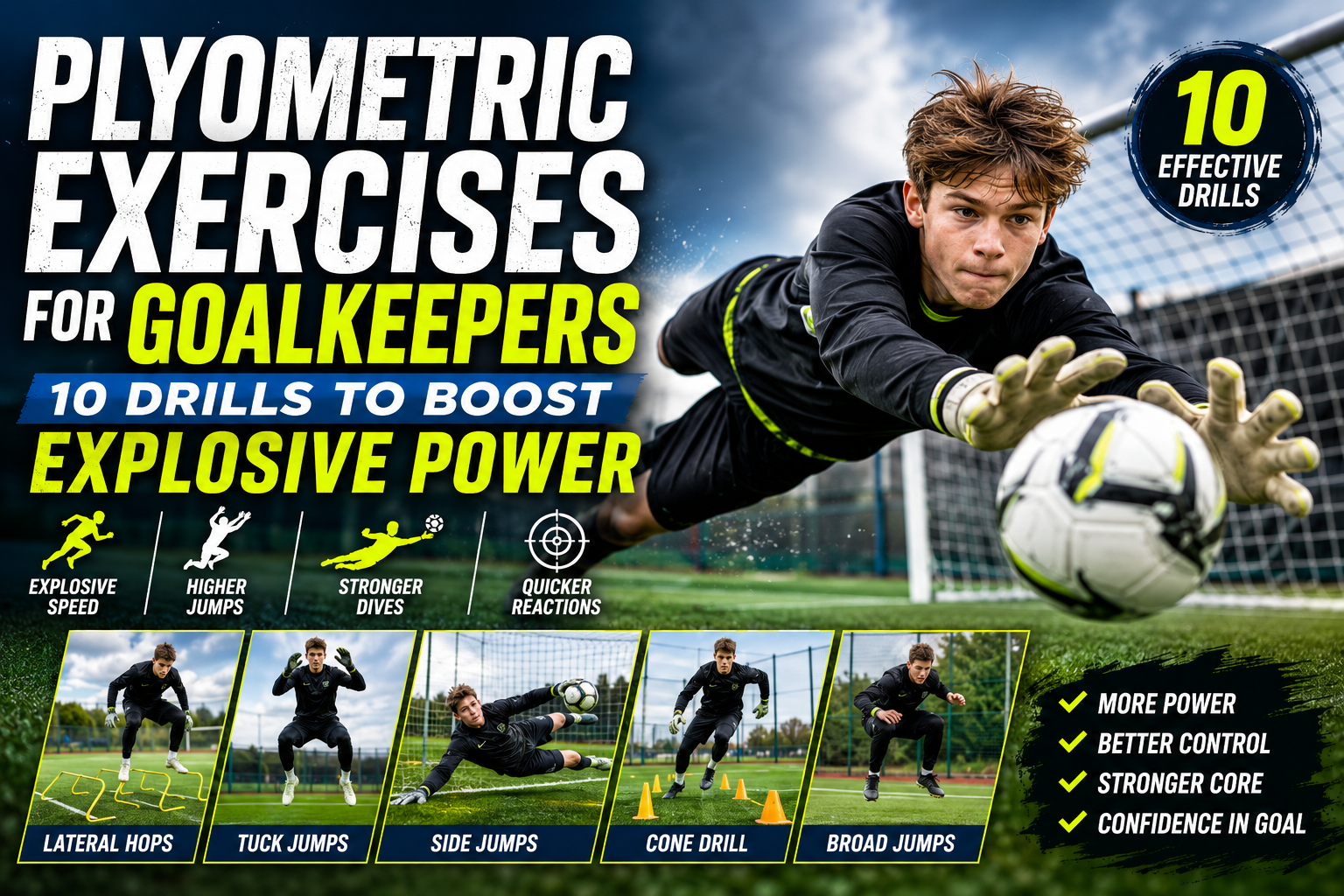
10 Best Plyometric Exercises For Goalkeepers
Below are 10 useful plyometric exercises for soccer goalkeepers. These drills are simple enough for young players to understand, but they still build real goalkeeper power when done with good form.
Start with the beginner level if you are new. Move to the advanced level only when your landings are clean and controlled.
| No. | Drill | Beginner | Advanced | Goalkeeper Benefit |
| 1 | Side-to-Side Hops | 2 x 15 | 3 x 20 | Improves lateral movement and foot speed |
| 2 | Front-Back Hops | 2 x 15 | 3 x 20 | Builds quick forward and backward reactions |
| 3 | Standing Jumps | 4 x 5 | 4 x 8 | Builds basic jumping power |
| 4 | Tuck Jumps | 5 x 6 | 5 x 10 | Develops explosive leg drive |
| 5 | Lateral Side Jumps | 5 x 6 | 6 x 10 | Helps with diving push-off power |
| 6 | Jump Squats | 4 x 6 | 5 x 10 | Builds lower-body power |
| 7 | Broad Jumps | 2 x 5 | 3 x 6 | Improves forward explosion and landing control |
| 8 | High Skips | 2 x 10 | 4 x 10 | Helps rhythm, bounce, and leg drive |
| 9 | Skiers | 3 x 8 | 4 x 10 | Builds side-to-side power and balance |
| 10 | Cone Drill | 4 x 3 | 4 x 30 seconds | Improves quick feet and direction changes |
This can be used as a basic best plyometric workout for soccer goalkeepers, but you do not need to do every drill every day. Choose 4 to 6 drills per session and focus on quality.
1. Side-to-Side Hops
Side-to-side hops are one of the best starting drills for goalkeepers. They train your body to move laterally, which means moving side to side.
Stand with your feet close together. Hop to one side, land softly, then hop back the other way. Keep your knees slightly bent and your body balanced.
This drill helps with quick movement across the goal. It also supports the small side steps you use before diving.
2. Front-Back Hops
Front-back hops train quick movement in a straight line. Goalkeepers use this when stepping forward to close space or moving back into position.
Keep your feet light. Hop forward, then backward. Do not land heavy. Try to stay on the balls of your feet.
This helps build fast foot contact with the ground, which is useful when reacting to loose balls or rebounds.
3. Standing Jumps
Standing jumps are simple, but they build a strong base.
Stand with your feet shoulder-width apart. Bend your knees, swing your arms, and jump as high as you can. Land softly and reset before the next rep.
Do not rush this drill. Each jump should be powerful. Good standing jumps can help goalkeepers jump higher for crosses and high saves.
4. Tuck Jumps
Tuck jumps are more intense. They build explosive power in the legs.
Jump up and bring your knees towards your chest. Land softly, reset, and repeat.
For young goalkeepers, control matters more than height. If your landings are loud or messy, slow down. This drill should build power, not bad habits.
5. Lateral Side Jumps
Lateral side jumps are one of the best plyometric drills to improve goalkeeper diving.
Start on one foot or two feet, then jump sideways with power. Land under control. Imagine pushing off to reach a low shot near the post.
This drill helps goalkeepers develop the side push needed for diving. It also improves balance after landing.
6. Jump Squats
Jump squats help build lower-body power.
Start in a squat position. Jump up with force, then land softly and return to the squat. Keep your chest up and your knees in line with your toes.
This drill supports strong legs, which are needed for diving, jumping, and quick recovery movements.
7. Broad Jumps
Broad jumps train forward power.
Stand still, bend your knees, swing your arms, and jump forward as far as you can. Land with both feet and hold your balance.
This can help goalkeepers when closing down attackers, moving off the line, or reacting to balls played into the box.
8. High Skips
High skips build rhythm, coordination, and leg drive.
Skip forward while lifting one knee high with each step. Drive your arms and stay tall.
This drill is not only about power. It also helps with movement timing, which goalkeepers need when stepping, jumping, and adjusting position.
9. Skiers
Skiers are great for lateral power and balance.
Jump from side to side like a skier. Land on one foot, then push to the other side. Keep your body controlled and your core tight.
This drill is useful because goalkeepers often need to move sideways, stop, and react again quickly.
10. Cone Drill
The cone drill helps with fast direction changes.
Set up cones in a small area. Move around them quickly using short steps, side shuffles, and quick turns. Stay light on your feet and keep your hands ready, just like you would in goal.
This drill connects plyometric movement with real goalkeeper footwork.
Do Not Forget Core Strength
Power does not only come from the legs. Goalkeepers also need a strong core.
A strong core helps you stay balanced when diving, landing, jumping, and changing direction. That is why core exercises for goalkeepers should be part of your routine.
Good core power exercises for goalkeepers include:
| Core Drill | Beginner | Advanced | Why It Helps |
| Plank Shoulder Taps | 3 x 10 | 4 x 14 | Builds core control and shoulder stability |
| Side Planks | 2 x 30 seconds | 4 x 30 seconds | Helps balance and side-body strength |
| Glute Bridge With Ball | 5 x 6 | 5 x 10 | Builds hips and lower-body control |
| Single Leg Balance | 2 x 30 seconds | 4 x 30 seconds | Improves landing control |
| Clam Shells | 4 x 8 | 5 x 10 | Strengthens hips for lateral movement |
These drills may not look as exciting as jumping exercises, but they help your body stay controlled. A powerful goalkeeper still needs balance.
How Often Should Goalkeepers Do Plyometrics?
For most young goalkeepers, 2 to 3 plyometric sessions per week is enough.
You should not do hard plyometrics every day. Your body needs time to recover. If you are also training with your team, playing matches, or doing gym work, keep the volume sensible.
A simple weekly plan could look like this:
| Day | Training Focus |
| Monday | Plyometrics and core |
| Tuesday | Technical goalkeeper training |
| Wednesday | Light cardio, stretching, or recovery |
| Thursday | Plyometrics and diving work |
| Friday | Handling, footwork, and distribution |
| Saturday | Match day |
| Sunday | Rest or mobility |
This keeps the training balanced. You build power without overloading your body.
Safety Tips For Young Goalkeepers
Plyometrics are powerful, but they must be done properly.
Always land softly. Your knees should not collapse inward. Your chest should stay controlled. Your feet should not slap the ground.
If you feel pain in your knees, ankles, hips, or lower back, stop and speak to a coach or trainer. Feeling tired is normal. Sharp pain is not.
Also, do not chase advanced drills too early. A clean simple jump is better than a messy hard jump. Build the basics first.
Final Thoughts
Plyometric exercises for goalkeepers help build the speed, power, and control needed for modern goalkeeping. They train the body to react fast, push off harder, jump higher, and recover quicker.
Good plyometrics for goalkeepers should include lateral movement, jumping, landing, short acceleration, and core control. That is why drills like side-to-side hops, tuck jumps, lateral side jumps, broad jumps, skiers, and cone drills are so useful.
The goal is not just to jump more. The goal is to move better in real match moments.
With a smart plyometric training for goalkeepers plan, young keepers can develop stronger dives, quicker feet, better balance, and more confidence in goal. Start simple, train with control, and build power step by step.