A goalkeeper can see danger that a defender facing the ball may miss: a runner at the back post, space opening behind the back line, or an attacker closing down a pass. Goalkeeper communication turns that view into useful information for the team.
The goal is not to shout for 90 minutes. It is to give the right instruction early enough for a teammate to act. Here is how to communicate as a goalkeeper during real game situations, with recent match examples and drills to practise.
Why is goalkeeper communication important?
Good defensive organization depends on players sharing information. The goalkeeper can help a defender decide whether to press an attacker, hold their position or track a run. On a cross, the goalkeeper must also make their own decision clear: are they coming for the ball, or should a defender deal with it?
The message needs to be short. “Sam, back post!” gives a player and an action. A long warning about the winger is likely to arrive too late.
A recent example comes from Bristol Rovers’ July 2025 match against Coventry City. Rovers lost 2–0, but their club report described goalkeeper Luke Southwood giving audible instructions to his defenders throughout the game as Coventry sent balls into the box. Southwood explained that he tries to spot danger before it happens and remind teammates about gaps. The result matters here: communication is a way to help a team defend, not a promise that it will never concede.
What should a goalkeeper say during a match?
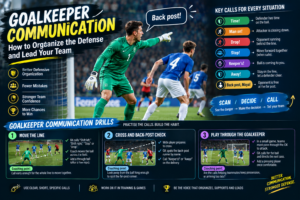
Goalkeeper verbal communication works best when the whole team agrees on a small set of calls. Keep the words consistent in training and games.
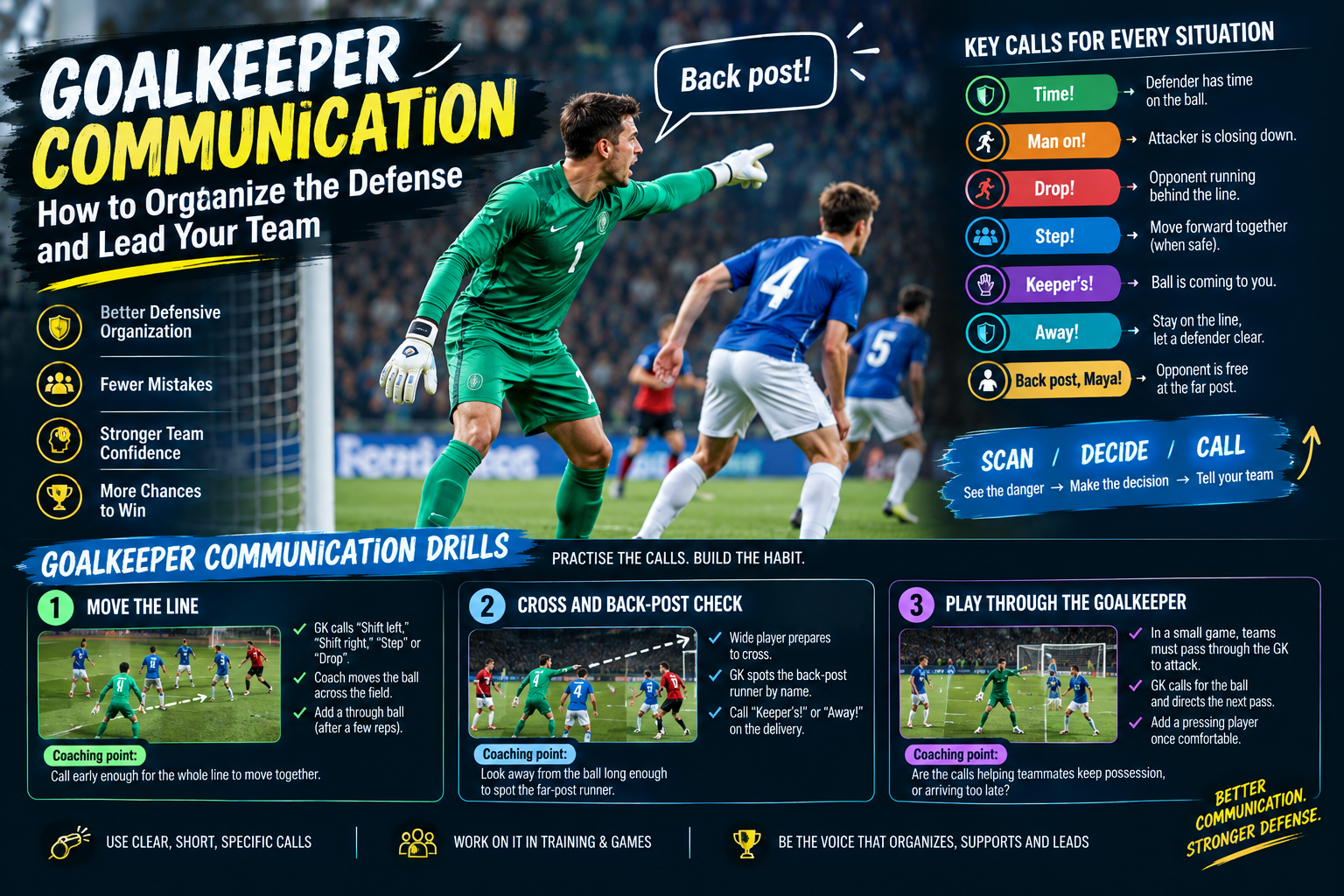
| Situation | Useful call | What it tells the team |
| Defender has time on the ball | “Time!” | You have room to look up and choose a pass. |
| Attacker is closing down | “Man on!” | Pressure is coming; act quickly. |
| An opponent runs behind the line | “Drop!” or “Runner behind!” | Turn and protect the space toward goal. |
| Defenders can move forward together | “Step!” | Move up as one line, when it is safe to do so. |
| Ball is coming into the goalkeeper’s reach | “Keeper’s!” | Leave the ball for the goalkeeper. |
| Goalkeeper will stay on the line | “Away!” | A defender must clear it. |
| Opponent is free at the far post | “Back post, Maya!” | Check and mark the named player. |
Use names when several defenders could respond. Avoid calling “Keeper’s!” unless you have decided you can reach the ball. If you change that decision, tell the defender immediately.
Goalkeeper leadership also includes calm words after a mistake. A clear “Next one—show me left” helps the team reset and gives the defender a job on the next play.
How to organize the defense in four common situations
1. When the ball moves wide
Scan across the whole penalty area, not only toward the player with the ball. Tell the nearest defender whether to close down the cross. Then check the centre and far post for unmarked runners.
In Spain’s 4–0 win over France in the June 2025 Women’s Under-19 EURO final, goalkeeper Laia López kept a clean sheet and dealt with two chances from Liana Joseph. UEFA’s tournament observers also singled out Laia’s communication with teammates and her commanding presence in the penalty area across the competition. They did not publish her exact calls, so the practical lesson is her role: stay connected to defenders while watching the whole area.
2. When a pass could go behind the back line
Your positioning and your defenders’ positions affect each other. If the team pushes high, watch the space behind it. Call “Drop!” early when a runner has a clear path onto a pass. If the ball is yours to reach first, make the decision and call for it.
A sweeper keeper sometimes leaves the penalty area to deal with these passes. That takes quick decision making. Before rushing out, judge the ball’s speed, the attacker’s run and whether a defender can cover. Your call should tell teammates what you intend to do.
3. When defending a corner or free kick
Give jobs before the kick. Identify who guards space, who marks a runner and who attacks the first ball. As the delivery comes in, use one clear claim or clearance call.
This is where goalkeeper organizing defense begins before the danger arrives. Waiting until the ball is in the air leaves little time to fix an unmarked player at the back post.
4. When your team wins the ball
Goalkeeper team communication matters in possession too. If a defender passes back to you, tell teammates whether you want a short option or space to play long. Scan before the ball arrives so your next action is ready.
In England’s 2025 Women’s EURO match against the Netherlands, Hannah Hampton played a low pass through the Dutch press to Alessia Russo in the move for Lauren James’s opening goal. UEFA’s technical observer explained that England had planned to create space for that pass. This is an example of a goalkeeper and teammates understanding their roles in distribution. It does not establish what Hampton said on the pitch; the takeaway is that a possession game needs shared decisions before the pass is played.
How to improve goalkeeper communication
Start by agreeing on words with your defenders. “Step,” for example, should mean the whole line moves up together, not that one centre-back runs forward alone. Ask defenders which calls they can hear clearly during a match.
Then practise the order: scan, decide, call. A goalkeeper who calls before looking may send a teammate the wrong way. A goalkeeper who sees the problem but waits too long cannot help.
After a game, review a few moments with the back line. Did anyone miss a runner? Was a claim call late? Was the instruction unclear, or was it simply too quiet? This makes goalkeeper command and control a shared skill rather than a test of who shouts loudest.
What are the best goalkeeper communication drills?
These goalkeeper communication drills put a decision behind every call. A coach should watch whether defenders respond, not just count how often the goalkeeper speaks.
Drill 1: Move the line
Place the goalkeeper behind three or four defenders. A coach moves the ball from one side of the field to the other while attackers make runs. The goalkeeper calls “Shift left,” “Shift right,” “Step” or “Drop.” Add a through ball after a few repetitions so the goalkeeper must judge whether the line should hold or retreat.
Coaching point: Did the goalkeeper call early enough for the whole line to move together?
Drill 2: Cross and back-post check
Set up an attacker wide, one in the middle and one arriving at the far post. As the wide player prepares to cross, the goalkeeper identifies the back-post threat by name. On the delivery, they call “Keeper’s!” if claiming or “Away!” if a defender should clear.
Coaching point: Did the goalkeeper look away from the ball long enough to spot the far-post runner?
Drill 3: Play through the goalkeeper
In a small game, require a team to pass through its goalkeeper before it can attack the opposite goal. The goalkeeper must move to offer a passing angle, call for the ball and direct the next pass. Add a pressing player once the team can do this comfortably.
Coaching point: Are the calls helping teammates keep possession, or are they arriving after a passing option has closed?
The competitor session plan uses similar ideas: moving a defensive line, involving the goalkeeper in passing play and training them to notice the side away from the ball. These are useful goalkeeper communication exercises because each instruction has an immediate result on the field.
How can goalkeepers communicate better with their team?
Make calls early, short and specific. Use a teammate’s name when needed, say what action to take and choose a volume that matches the urgency. During goalkeeper coaching and team communication drills, give defenders a chance to say which words help them most.
The best test is simple: after you speak, does a teammate know what to do? When the answer is yes, your voice becomes part of the team’s defending and attacking play.