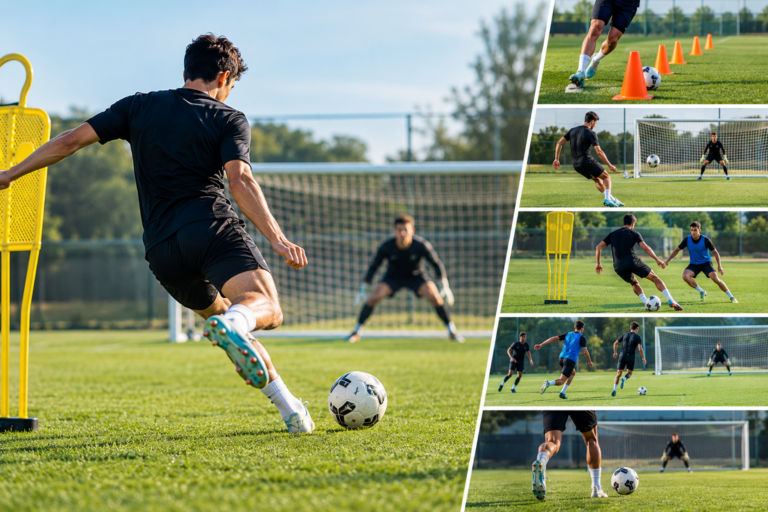
Picture a Saturday morning U14 game. Your central midfielder takes a pass with their back to goal, spots a defender closing in, panics, and boots it straight to the other team. You groan. Again.
That moment is where most of these mistakes start, so it’s worth building practice around it. The midfield soccer drills below are short and cheap. They’re midfielder drills soccer coaches can set up between water breaks, with a handful of cones and whatever balls aren’t flat.
What Midfielders Actually Do
So what are the roles of a midfielder? Short answer: connect. They link attack and defense, win loose balls, play it forward, and keep no one out on an island. People are obsessed with midfielder roles…truth be told, it doesn’t really change.
What moves is the system. In a 4-4-2 formation, two central players split things, one holding while the other pushes up. A 4-3-3 formation puts a single anchor behind two runners. Then comes the 3-5-2 formation, which asks the three in the middle to cover everything because the wing backs are busy up the sideline. Those midfield responsibilities are heavy.
Inside the middle there’s another split. A defensive midfield player sits in front of the back four, wins duels, and keeps passes short. An attacking midfield player works nearer the forwards, hunts pockets of space, and takes chances. The best midfield players in either job look around early and keep moving.
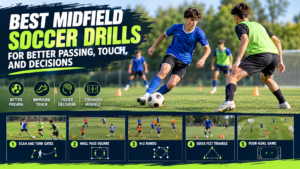
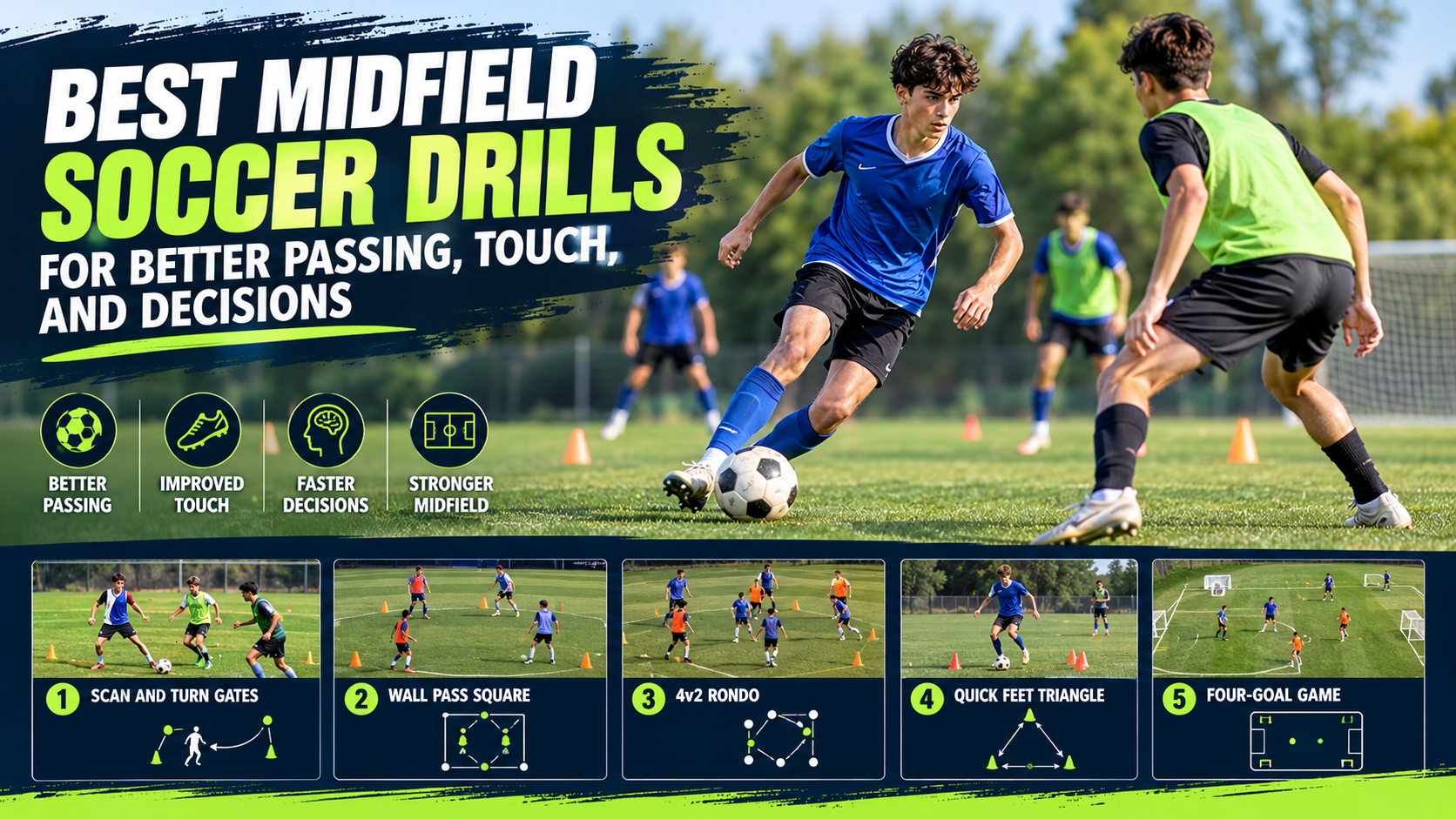
Drill 1: Scan and Turn Gates
Start with scanning. That’s a quick glance over the shoulder before the ball arrives, then another one. Players who do it get a free preview of the next two seconds. Players who don’t are guessing.
Set up a 15×15 yard grid with cone gates all the way around it. Three players to each group: one passer, one midfielder, and one defender putting a little pressure (a light push, not hard). Passer feeds in, midfielder checks, takes the ball across body, leaves through any open gate.
Curious how to turn with the ball in soccer? Open your hips, first touch away from the defender, push off with the outside of the foot. That’s the whole thing. Good midfielder turns aren’t fast. They turn early.
Drill 2: Wall Pass Square
This one trains what happens right before the pass, which most drills ignore. Make a square, 10 by 10 yards, with one target player per side.
- The midfielder in the middle passes to a target.
- Move. Find a new spot and ask for the return from a different target.
- Pass to a third target and start over.
Two cues are worth repeating. First, body positioning: stand side-on so the ball and the lane both stay in view. Second, receive on the back foot, the foot farther from the passer. Your chest ends up facing the field, and you’ve bought half a second.
Go two touches at first, then one when they’re comfortable.
Drill 3: 4v2 Rondo
Everyone runs rondos. Not everyone coaches them. Put four players on the outside of a 12 by 12 yard square and two defenders inside. Keep the ball. Lose it, and you swap in.
Yes, it’s possession. But the real gains are sneakier. Under pressure, players build ball control and start spotting lanes before they open. That’s spatial awareness, and you can’t lecture it into anyone.
What deserves the coaching is the movement of players without the ball. Off-the-ball movement decides whether a rondo flows or stalls. Tell them to shift into new angles every time. Standing still in a straight line is what kills it. Young group? Use a bigger square.
Drill 4: Quick Feet Triangle
Three cones, eight yards apart, shaped like a triangle. A server stands in the middle. The midfielder passes to the server, sprints around a cone, takes the return, turns, and plays to a target. Swap directions every rep. It’s a turn and pass drill, just with some lungs involved.
Agility improves too, almost by accident. A few of the footwork ideas in these goalkeeper footwork drills work for midfielders as well. Keep rounds near 30 seconds. After that, the touches go sloppy, and you’re just practicing bad habits.
Drill 5: Four-Goal Game
Transition is what happens the second the ball switches sides. Midfielders live there. Play 5v5 on a 40 by 30 yard field with two small goals at each end. Each team defends two and attacks two.
Players quickly learn they can’t just go forward. They have to look for the open side, which is decision-making in real time. The best carriers drag a defender one way, then switch, which is creating space on purpose. And vision? You’ll spot it in whoever finds the empty goal first, because their head is up.
Putting It All Together
How to improve midfield play is about drills for repetition with a purpose. Choose one theme a week. This week, passing next. Spend 15 minutes on the drills, then finish with a small-sided game so it’s all put to the test when it’s imperfect. Don’t know where to start? Start with the easiest-to-replicate midfielder drills soccer teams can do – the rondo.
Good midfield training drills for soccer feel like a real match: tight space, a defender close, a choice to make. Mix in some football midfield drills that isolate one skill, then see if it holds up live.
A few football tips for midfielders that cost nothing: talk all game, check your shoulder before every pass, and scan early. A rushed pass back to the keeper is behind plenty of common goalkeeper mistakes.
Final Thoughts
The best midfielders aren’t always the fastest or the flashiest. They just see things a beat earlier. Run these midfield soccer drills a couple of times a week for a month and notice how much calmer your passing gets.
FAQs
1. How often should midfielders train these skills?
Two or three short sessions a week is plenty. Fifteen focused minutes beats an hour of going through the motions.
2. How can I practice passing alone?
Find a wall. Pass from different distances with two touches, and aim at a small target like a cone or a chalk mark.
3. How do I get better in tight spaces?
Use small grids with a light defender. You’ll learn to shield the ball with your body and spot the next pass before pressure lands.
4. Can youth players use these drills?
Yes. Go bigger on the grid, drop a defender, and slow the pace. Keep the instructions short and let kids repeat each one.
5. How can midfielders make faster decisions?
Look before the ball arrives and pick your next move. Games with limited touches force quicker choices than isolated drills do.
6. What else should midfielders work on?
Fitness, mostly, since midfielders run more than almost anyone. Also watch games and note where good midfielders stand before they receive.