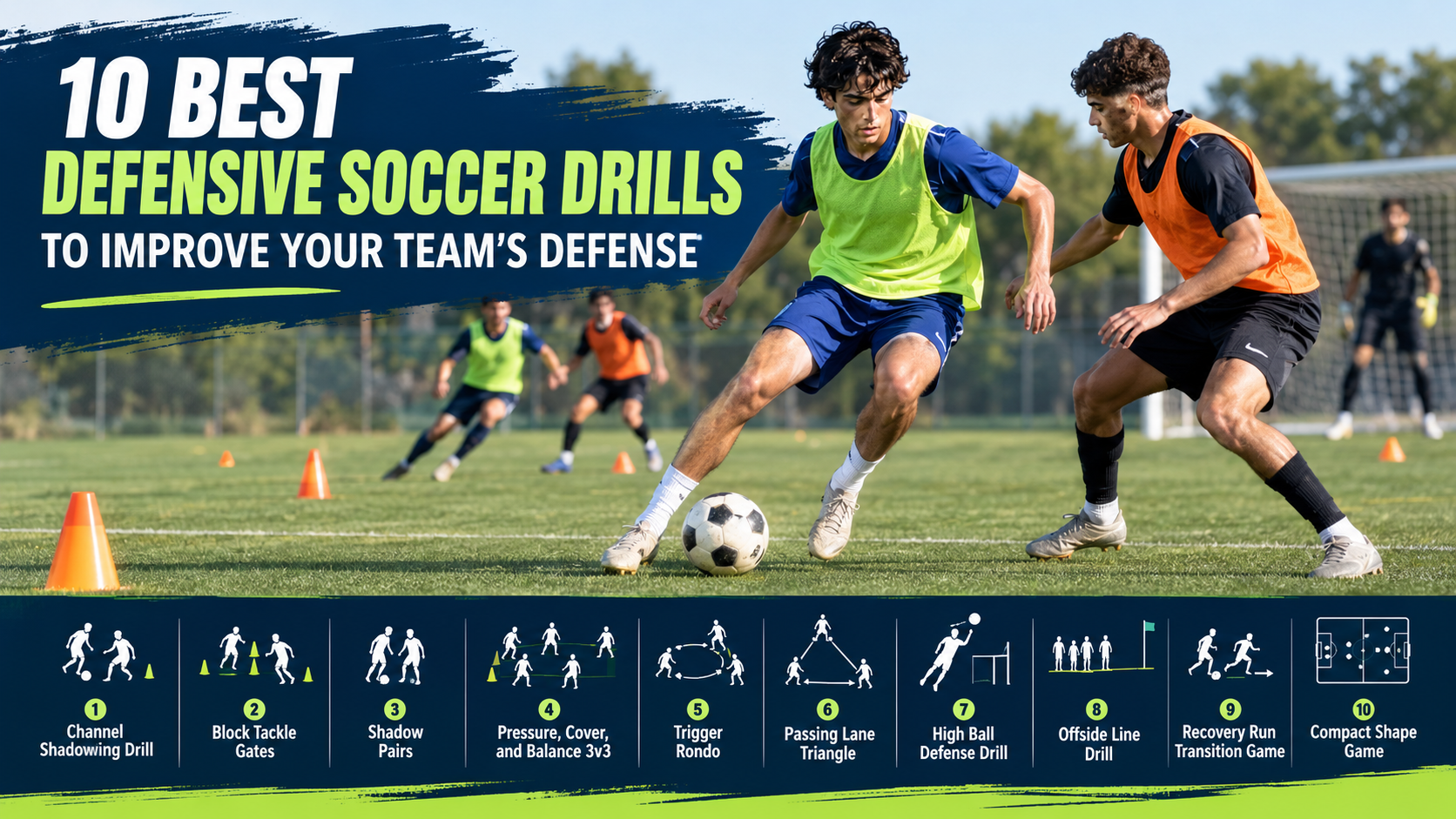
Study enough youth games, and you’ll see that goals rarely come from genius. They come from a space left open, from a runner no one supported, from a player frozen in place with no one threatening him. All of that is teachable.
Start with the basics. How do you play defense in soccer? You stay goal side, you stay close to the teammates around you, and you talk constantly. The drills below each train a piece of that.
Wondering how to improve soccer defense without a complicated plan? These defensive soccer drills need only cones, bibs, and a few balls. They’re drills for defense soccer coaches can run at almost any level, from a rec team to a high school varsity squad.
1. Channel Shadowing Drill
Jockeying is giving way slowly so the attacker can’t step past you.
Make a 10×20 yard lane. One attacker dribbles end to end, while a defender begins two yards behind, low and just to the side of the dribbler, attempting to herd the attacker to the sideline. Be alert for diving.
Add a mini goal to raise the difficulty. For younger kids, shorten the lane.
2. Block Tackle Gates
Tackling usually gets squeezed into the last five minutes of practice. Give it real time. Line up a few gates, two cones about a yard apart, across a grid. The attacker dribbles at a gate. The defender closes, plants the standing foot, and wins the ball with the inside of the other.
Start at half speed. Timing matters more than strength, so coach players to step in when the attacker’s touch gets heavy instead of diving in while the ball is glued to their feet.
3. Shadow Pairs
Man-to-man marking sounds easy until you try it for ten straight minutes. Put six pairs in a 30 by 30 yard box. One player in each pair roams while the partner sticks. A coach feeds balls in, and attackers try to turn.
Defenders stay goal side and ball side, with one eye on the ball and one on their player. Marking collapses fast when nobody speaks, so make them call “mine” and “switch” out loud. That’s one of the easiest tips on defending in soccer, and it costs nothing. Swap partners often.
4. Pressure, Cover, and Balance 3v3
Of all the pressure cover balance soccer drills around, this one gets the most use. The player nearest the ball applies pressure. A second defender covers behind and a step to the side. The third gives balance, sliding across to watch the far side.
Use half a field with a goal and keeper. Three attackers start at midfield against three defenders. Whoever is closest goes to the ball, and the others shape around that choice. After each pass, the roles change.
Freeze the game now and then to show spacing. Younger teams can start with 2v1 and only learn pressure and cover.
5. Trigger Rondo
Pressing works when everybody goes at once. A lone chaser mostly wastes energy. A 5v2 rondo is a quick way to teach that.
Build a 12 by 12 yard square with five passers outside and two defenders inside. One defender hunts the ball while the other cuts off the next pass. Win it and you swap with whoever lost it. Rotate the pair often, since this is tiring work.
Give players cues for when to go: a heavy touch, a pass back, a teammate receiving with their back to goal. Without cues, they’ll chase every pass and be gassed in five minutes.
6. Passing Lane Triangle
Interception is about reading the passer’s body, not sprinting at the ball. Set three cones about 15 yards apart with an attacker on each, and place one defender in the middle.
The defender curves their run to cut the lane rather than running in a straight line. Touch the ball and you swap places with whoever made the pass.
Tell them to move when the passer’s foot swings back. Later, add a second defender or limit attackers to two touches. These football drills suit center backs as much as midfielders.
7. High Ball Defense Drill
Clearing the ball won’t win any beauty contests. That’s fine. A good clearance goes high, wide, and well away from your goal.
Have a server near the touchline whip balls into the box. Two attackers crash in against two defenders. Defenders attack the ball first, then head or kick it toward cone-marked wide zones. Award a point for each one that lands past the cones.
Players should pick the safe side and never send it through the middle. Add a keeper so everyone learns who calls for the ball, and spend time on keeper positioning on crosses so the back line knows where help is.
8. Offside Line Drill
The offside trap can win a match or lose it, so rehearse it before you spring it on a Saturday. Line up four defenders with a server at midfield and two attackers ready to run in behind.
When the server’s head drops to strike the ball, the line steps up together. Usually the center back shouts “up.” A coach with a flag signals offside. Without a flag, a coach can raise a hand. Most failures come from one defender who stays deep and keeps everyone onside.
Repeat the call until it’s reflex. With young teams, skip it and teach a plain “hold the line” instead.
9. Recovery Run Transition Game
Everyone gets beaten sometimes. The better defenders just get back quicker. Plenty of goals begin with common goalkeeper mistakes like a rushed pass out, which leaves the back line scrambling.
Play 4v4 in a 40 by 30 yard area with a goal at each end. When a team loses the ball, it has five seconds to get goal side. Players should sprint back at an angle toward their own goal instead of chasing from behind.
This trains the defending skills that decide late games, when legs feel heavy. Give a point to the first player back and it becomes a race.
10. Compact Shape Game
Now see if the earlier work sticks. This game takes the drills for defense soccer players learned in pieces and asks them to use everything together. It’s also one of the best team defense soccer exercises for teaching a group to move as one.
8v8 play on half a field; use two small goals. When defending, stay connected and keep lines about 10 yards apart, shifting together as the ball moves. Give a point for a backward pass, or wins ball inside shape. Pause play and show where gaps are.
These defending techniques only work if everyone commits, so give team accomplishments more clout than individual team plays.
Final Thoughts
Soccer defense gets better through small habits repeated week after week. So what are the best soccer defense drills? The ones that match what your team actually faces on Saturday. Pick two or three of these defensive drills each week, fold them into your regular soccer training, and keep the sessions short. Return to the defensive soccer drills that expose your biggest gaps.
FAQs
1. How frequently should a team practice defensive drills?
A few short blocks a week is enough. Ten to fifteen high quality minutes, repeated regularly, is more effective than a single long session that exhausts all participants.
2. How do you tell what press and jockeying mean?
Pressing is an attacking press to win the ball, often as a unit. Jockeying is the waiting game of tiring out an attacker before any other defender arrives.
3. Can youth teams use these drills?
Yes. Constrict the grids, trim the numbers, and decelerate. Bypass the offside trap with young sides and emphasis on stance, distance and talking.
4. How will I know if our team defense is getting better?
Track shots allowed, goals conceded, and how often your players win the ball in your half. Just watching a few games on video will reveal the problems of spacing.
5. Do forwards and midfielders need defence training too?
They do. Defence begins at the first line of pressure – therefore every player should know when to push up, when to hold your line and when to get back.
6. What equipment do I need?
Cones, balls, bibs and one or two goals – that’s it. Just a few flags are needed for offside work but you can do without them.