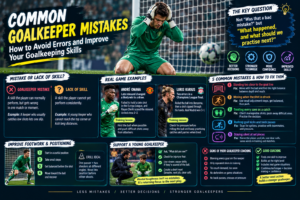
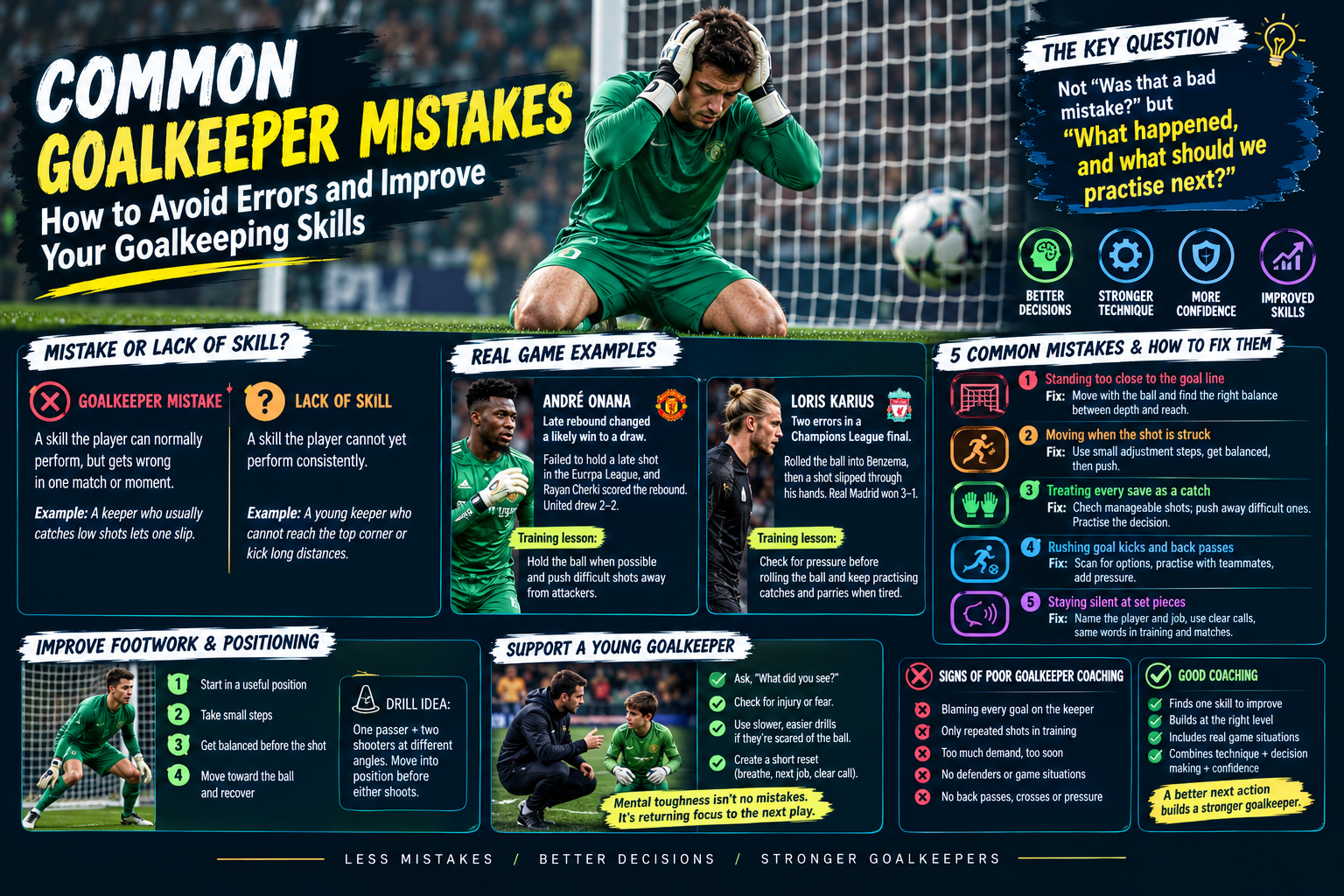
A missed catch can be painful to watch, especially when it leads to a goal. But the useful question is not “Was that a bad goalkeeper mistake?” It is “What happened, and what should we practise next?”
Some goalkeeper mistakes come from a rushed decision or poor technique. Others show a skill that a young player has not developed yet. Knowing the difference helps players improve and helps coaches respond fairly.
What is the difference between a goalkeeper mistake and a lack of skill?
A goalkeeper mistake is an action the player can normally perform but gets wrong on one occasion. For example, a keeper who usually catches a low shot lets one slip through their hands.
A limitation is a skill the player cannot yet perform consistently. A young keeper who cannot reach the top corner or kick beyond a certain distance may need more practice, better technique or time to grow. Calling every goal they concede a mistake hides what they need to learn.
The distinction matters most in youth goalkeeper development.
| What you see | Possible cause | Useful response |
| A usually reliable keeper drops one catch | One-off error | Review the action, then practise a few clean catches |
| The keeper often struggles to hold low shots | Handling technique needs work | Practise body position and catches at a suitable pace |
| A child cannot reach a high corner | Current height, strength or diving range | Work on starting position and movement; do not blame them for being unable to reach it |
| Passes repeatedly go to an opponent | Choice, first touch or passing skill | Practise scanning and goalkeeper distribution under realistic pressure |
Real games show why details matter
Professional examples can help explain an error without turning it into a label for the player.
André Onana: a late rebound changed a likely win to a draw
Manchester United led Lyon 2–1 late in the first leg of their April 2025 Europa League quarter-final. After André Onana failed to hold a late shot, Rayan Cherki scored the rebound and the match ended 2–2. An earlier Lyon free kick had also reached the net past Onana. United went on to win the two-leg tie, but the late goal cost them a win that night.
Training lesson: In shot stopping, a save is not finished when the first shot is blocked. Work on holding the ball when possible and pushing difficult shots away from attackers.
Loris Karius: two errors in a Champions League final
In the 2018 Champions League final, Liverpool goalkeeper Loris Karius tried to roll the ball out while Karim Benzema was close enough to intercept it and score. Later, a Gareth Bale shot slipped through Karius’s hands. Real Madrid won 3–1. Liverpool had equalised after the first error, which shows that the match remained competitive; nobody can know whether Liverpool would have won without the mistakes. They did lose a chance to stay in the contest on better terms.
Training lesson: Check for pressure before rolling the ball to a teammate, and keep practising catches and parries when tired. One mistake should not determine how the keeper approaches the next ball.
Five common soccer goalkeeper mistakes and how to fix them
1. Standing too close to the goal line
If a keeper stays on the line for every attack, they may leave too much space for a forward to receive a through ball. If they rush too far out, the forward may play around them.
Fix: Practise moving with the ball as it travels across the field. Pause a drill and ask, “From here, can you protect the goal and reach a pass behind the defenders?” Then restart at game speed.
2. Moving when the shot is struck
A keeper who is still taking a large step may struggle to push off for a save. Better footwork and agility help them arrive in a balanced position before the shot.
Fix: Use short adjustment steps as the attacker prepares to shoot. Get balanced, watch the ball and then push toward it.
3. Treating every save as a catch
Trying to hold a hard shot that should be pushed wide can leave a rebound in front of goal. Pushing away an easy ball can also give the other team another attack.
Fix: Practise the decision as well as the movement: catch a manageable shot; guide a difficult one away from danger. Vary the pace and angle in training so the keeper has to choose.
4. Rushing goal kicks and back passes
Poor goalkeeper distribution is not always a weak kick. A keeper may miss an open teammate, pass toward pressure or take a heavy touch from a back pass.
Fix: Before receiving the ball, look for a short option and a safe longer option. Practise goal kicks with teammates taking their match positions. Add a pressing attacker once the keeper can choose calmly without pressure.
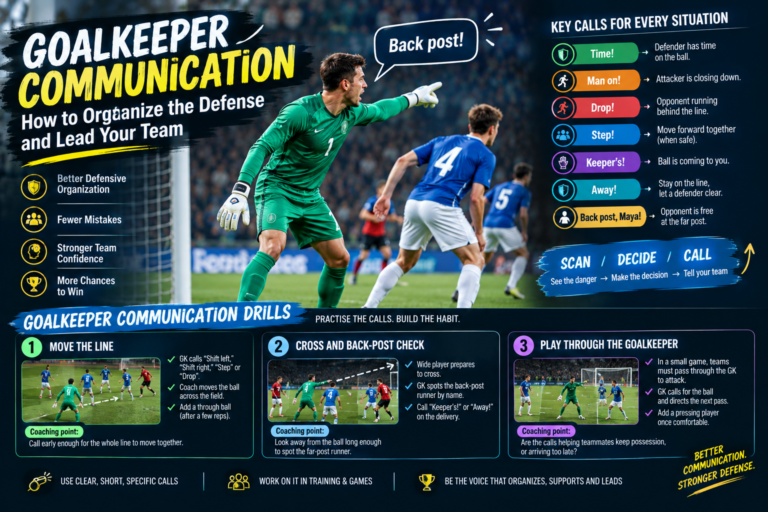
5. Staying silent at set pieces
A keeper can see a free attacker that a defender has missed. Poor set piece organization may leave that player unmarked at a corner or free kick.
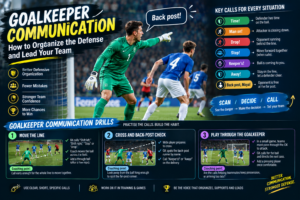
Fix: Before the delivery, name the player and the job: “Alex, back post.” On the cross, make a clear call if coming to collect it. The keeper and defenders should use the same words in practice and matches.
How to improve a goalkeeper’s footwork and positioning
Do not start with spectacular dives. Start with repeatable movements:
- Begin in a useful position as the ball moves wide or central.
- Take small steps to stay in line with the ball.
- Get balanced before the shot.
- Move toward the ball and recover for a possible rebound.
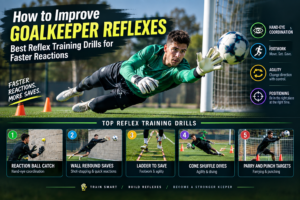
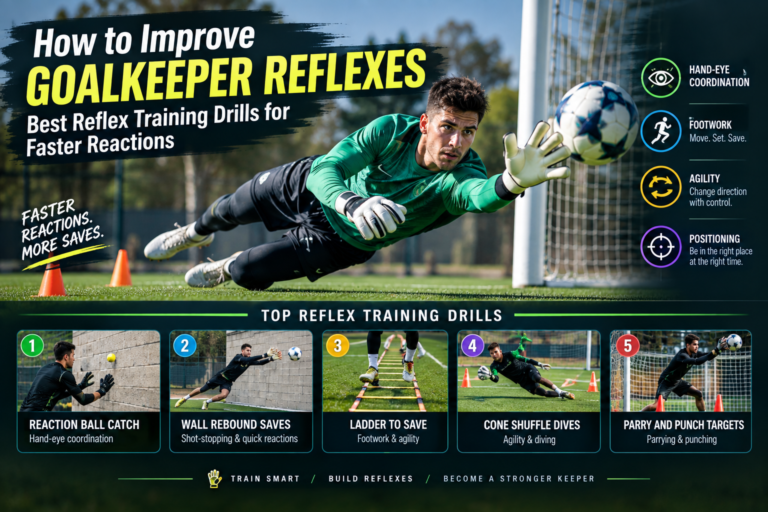
A simple drill uses one passer and two shooters at different angles. The passer changes the point of attack; the keeper moves into position before either shooter strikes. Coaches can change the distance and shot speed to suit the player. This builds goalkeeper technique before asking for more goalkeeper explosiveness or a longer diving range.
How to support a youth goalkeeper after conceding a goal
First, give them a moment. A question such as “What did you see?” is more useful than announcing what they did wrong in front of the team. Check whether the keeper was hurt or frightened, particularly after a close-range shot.
If the child is scared of the ball, lower the speed and distance in practice. Begin with gentle throws and predictable shots, then increase the challenge as confidence grows.
To help a keeper stop dwelling on a mistake, agree on a short reset: take a breath, identify the next job and give one clear instruction to a defender. Review the mistake after the match, when the player can listen and practise a solution.
Mental toughness is not pretending a goal did not hurt. It is learning to return attention to the next play.
What are signs of poor goalkeeper coaching in youth soccer?
Be concerned if every conceded goal is blamed on the keeper, training consists only of repeated shots, or a coach demands kicks and dives the child cannot yet perform. Also watch for drills that never include defenders, back passes, crosses or decisions under pressure. Those are regular parts of the position.
Good goalkeeper coaching identifies one skill to improve and gives the player a chance to practise it at an achievable level. A useful goalkeeper training plan might pair one footwork exercise with handling practice and a small game involving distribution. As the keeper improves, the coach adds speed, movement and pressure.
The purpose of reviewing bad goalkeeper mistakes is to find a better next action. A keeper’s match is bigger than its most visible error, and steady work on decisions, technique and confidence improves the actions that happen long before a shot reaches the goal.