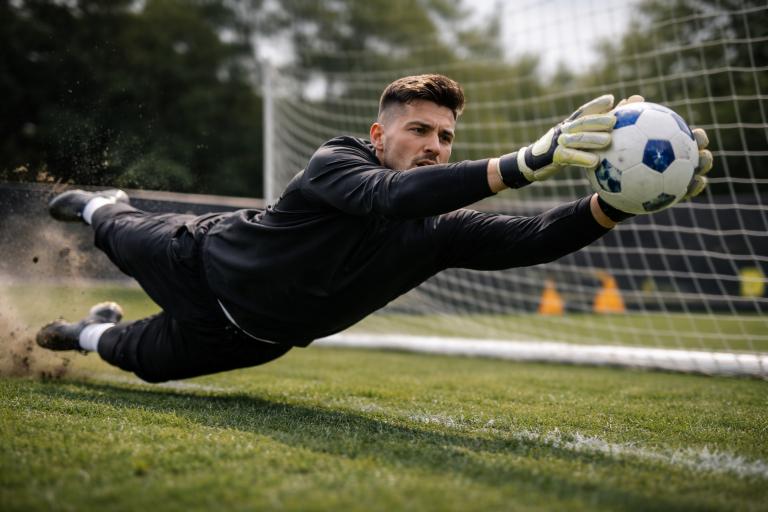
There’s a split second where you know the shot is out of reach—unless you move.
That’s where diving becomes everything.
For many players, learning how to dive as a goalkeeper feels intimidating at first. It’s not just about stopping the ball, it’s about trusting your movement, committing fully, and landing safely without hesitation.
At ELP Goalkeeping, this is one of the most important skills developed early. Because once a goalkeeper understands proper goalkeeper diving technique, everything changes. Shots that once felt impossible suddenly become reachable.
Good Footwork Is What Makes the Dive Possible
Most people think the dive is the save. It’s not.
The save starts with your setup. Your stance, your balance, and especially your footwork determines whether you’ll reach the ball or not.
A strong setup includes:
- Balanced stance with slight forward lean
- Quick adjustment steps toward the ball
- Staying light on your feet for explosive movement
This is where goalkeeper shot stopping technique begins. Without proper positioning and movement, even the best dive won’t get you there in time.
This foundation improves significantly in structured environments like private goalkeeper training Connecticut, where footwork and positioning are constantly refined. These small adjustment steps are what create balance before the dive. When your feet are set properly, your body can explode in any direction without hesitation. Without this control, even strong dives feel rushed or off-balance, which reduces both reach and effectiveness.
Seeing the Save Before You Make It: Vision and Tracking
Before your body moves, your eyes do.
One of the most overlooked parts of how to dive as a goalkeeper is visual tracking. The moment the shot is taken, your ability to read the ball’s direction, speed, and trajectory determines how effective your dive will be.
This is where hand-eye coordination and reaction time come together. Instead of reacting late, you begin to recognize patterns—body shape, striking angle, and ball movement—almost instantly.
Strong visual tracking improves your goalkeeper diving technique because it allows you to move earlier and more efficiently. The better you see the save, the easier it becomes to execute it.
How to Generate Power in Your Dive
Once you’ve read the shot, everything comes down to how you explode into the dive.
Your power doesn’t come from throwing yourself sideways—it comes from pushing off correctly. A proper soccer goalkeeper diving technique starts with driving off your outside foot and pushing your body toward the ball with intent.
This is where goalkeeper explosive dive training becomes critical. The stronger your push-off, the more distance you cover, and the more confident you become in reaching difficult shots.
Not Every Dive Is the Same—Here’s How Top Keepers Adjust Instantly
Not every dive looks the same, and that’s where many goalkeepers struggle.
Your technique must adapt based on the shot. For lower shots, the goalkeeper low dive technique focuses on getting down quickly while staying compact. Mid-height saves rely on a controlled goalkeeper side dive technique, while full-stretch dives demand maximum reach and commitment.
This ability to adjust is what separates average players from those who consistently perform. Training environments like group goalkeeper training Connecticut help develop this adaptability through repeated game-like scenarios.
The Part Everyone Fears (And Why It Shouldn’t Hold You Back)
One of the biggest reasons goalkeepers hesitate is fear of landing.
But once you understand proper goalkeeper safe landing technique, that hesitation disappears.
A safe landing includes:
- Landing on your side, not your elbows
- Absorbing impact across your body
- Securing the ball before hitting the ground
When you trust your landing, your entire goalkeeper diving technique improves. You stop holding back and start committing fully to every save. Over time, this builds confidence in your movement. When you know you can land safely, you stop second-guessing your decisions. That confidence is what allows goalkeepers to commit fully, especially in situations where hesitation would otherwise cost a goal.
How to Time Your Dive Correctly
Diving isn’t just about how you move, it’s about when you move.
Too early, and the attacker adjusts. Too late, and the ball is already past you. Strong goalkeeper dive timing drills train your reaction, so you move at the exact right moment. You’re reading body shape, shot direction, and reacting instantly. This is also where goalkeeper lateral dive drills play a major role, improving your ability to move quickly across the goal and react under pressure.
Training in environments like goalkeeping camp training helps develop this instinct through repetition, making your reactions faster and more natural. Consistency is what turns technique into instinct. The more often you repeat these movements with proper form, the less you need to think about them during a game. Your reactions become automatic, and your focus shifts from mechanics to simply making the save.
How to Improve Your Diving Through Training
Diving becomes effective when it’s no longer something you think about—it’s something you do.
Consistent goalkeeper diving drills turn technique into instinct. Through repetition, your movement becomes smoother, your reactions faster, and your confidence stronger.
Effective training includes:
- Controlled goalkeeper diving practice exercises to refine technique
- Reaction-based drills to improve speed
- Goalkeeper power dive training to increase distance
- Repetition under pressure to simulate real match scenarios
This is also where the benefits of private soccer goalkeeper training become clear, as detailed feedback helps refine even the smallest movements.
Bringing It All Together
There’s a clear difference between goalkeepers who hesitate and those who commit.
Learning how to dive as a goalkeeper isn’t just about mechanics—it’s about trust. Trust in your technique, your movement, and your ability to land safely.
Mastering goalkeeper diving technique allows you to react without hesitation and reach shots you once thought were impossible.
At ELP Goalkeeping, this is the difference that stands out. Goalkeepers who commit fully don’t just attempt saves—they make them.
Frequently Asked Questions
How can goalkeepers improve their diving distance?
By improving leg strength, push-off technique, and practicing explosive dive movements, goalkeepers can increase how far they reach during a save.
What muscles are important for goalkeeper diving?
Legs generate power, the core provides stability, and the upper body helps control the dive and secure the ball.
Should goalkeepers practice diving every training session?
Diving should be practiced regularly, but with proper technique and recovery to avoid fatigue or injury.
What type of drills improve goalkeeper diving?
Drills that focus on reaction time, lateral movement, and explosive power are most effective.
How do professional goalkeepers train their diving ability?
They combine strength work, technical drills, and repeated match scenarios to build consistency and confidence.