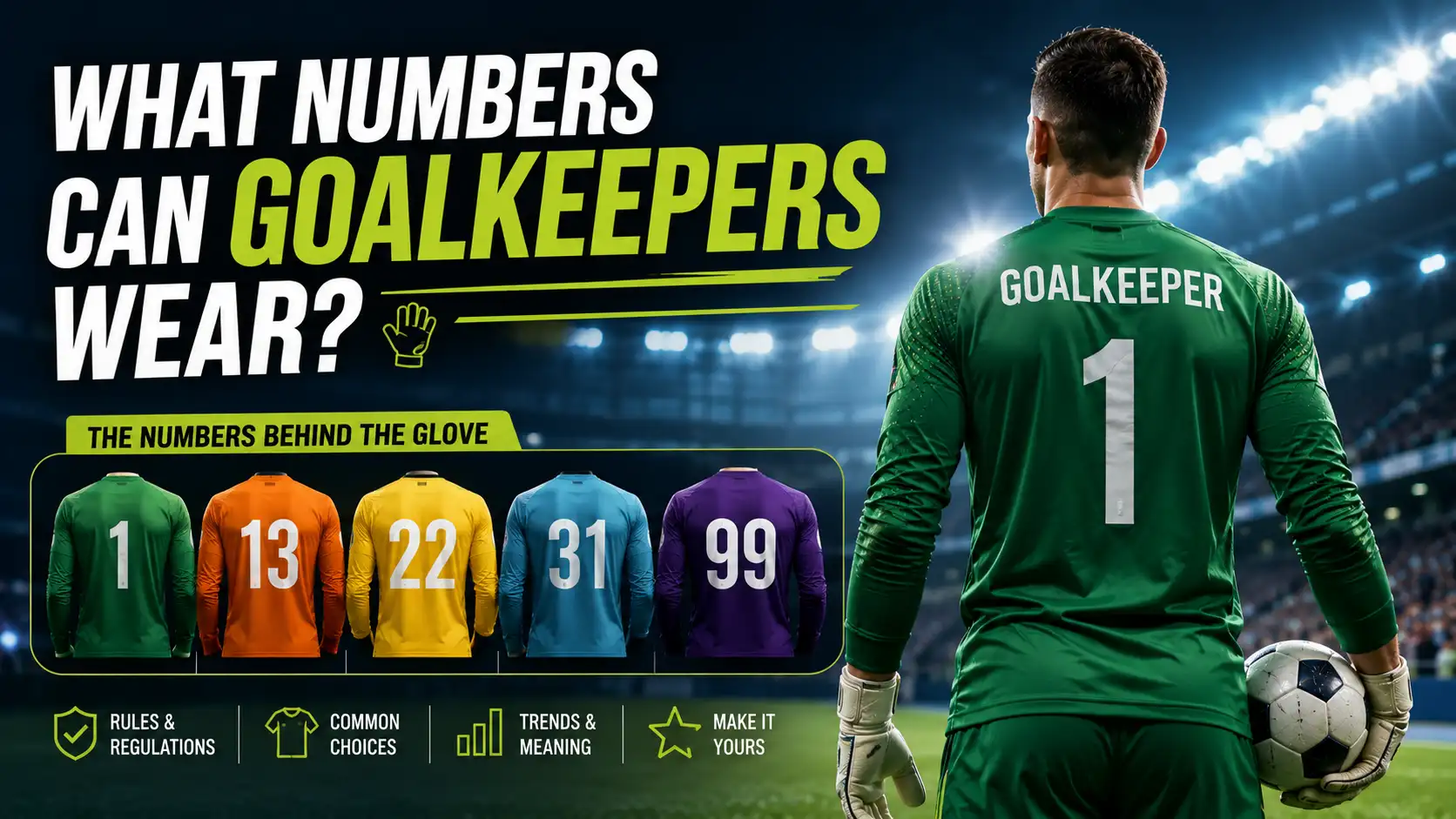
Walk into almost any youth soccer practice and ask a kid what number they want in goal. There’s a good chance the answer is “one.” That instinct isn’t random. Goalkeeper numbers carry more tradition than almost any other numbering pattern in the sport, and the story behind them is more interesting than a simple rule.
Is There Actually a Rule for This?
Not really, at least not from the top down. Under IFAB’s Laws of the Game, a shirt must carry a number. That number has to be visible and different from every other player on the team. IFAB goalkeeper number rules never say which digit a keeper has to wear. The requirement is about identification, not tradition.
That distinction matters because most of what people assume is a “rule” is actually a habit. Different leagues formalized these habits on their own, in their own way. A young keeper trying to make sense of soccer goalkeeper rules in general benefits from knowing which requirements are truly global and which ones are just tradition dressed up as law.
A youth club, a national federation, and a professional league can all handle goalkeeper numbers differently. All of them can still follow the Laws of the Game correctly.
Why No. 1 Became the Default
Soccer goalkeeper number 1 goes back to the earliest days of numbered shirts. Teams lined up in a set formation. Numbers ran roughly from back to front, and the keeper stood furthest from the goal, so they got the lowest number. The Football Association was one of the first governing bodies to formalize numbered shirts in English football, and the habit never really left. Tactics changed a lot over the decades. Outfield spots shifted around constantly. The goalkeeper’s spot barely moved, and the number stuck right along with it.
Squad numbers needed backup digits once substitutes became normal. A team with two or three keepers can’t give them all the number 1. That’s where a lot of the odder numbering habits actually came from.
The Other Numbers Keepers Wear
What number do goalkeepers wear when they’re not the starter? A backup goalkeeper number has become almost as traditional as No. 1 itself. Every Back-up Goalkeeper eventually inherits one of a handful of digits that show up again and again across different eras and leagues:
- 12 was one of the earliest backup numbers, especially once a second substitute became common in the late 1980s
- 13 became the standard second-choice number in England once squad numbers arrived in the early 1990s, partly because outfield players rarely wanted it
- 16 shows up constantly across European squads, tied to the days when five substitutes were named and a reserve keeper often took the last number on the list
- 22 was a common international choice before squad numbers became fixed at club level, often paired with 12 for a team’s two keepers
- 30 tends to appear at clubs with larger, deeper squads, usually as a third-choice number once the lower digits are taken
Almost none of these are official requirements. They’re inherited habits, repeated so often across decades that they started to look like rules.
Spain and La Liga’s Strict Numbering System
Not every competition just lets it sit there as tradition. La Liga (Spain) is one of the clearer exceptions; it’s kind of the point. Its numbering approach is a real rule, not some idle habit. Clubs have to submit a 25-man first team squad using numbers 1 to 25, and the goalkeepers have to wear 1, 13, or 25. Anyone brought in from the reserves during the season gets numbers from 26 up to 50.
Still, even a strict rule runs into rough patches sometimes. Girona had all three goalkeeper numbers occupied across the 2025-26 season. When the club added another keeper, that signing needed extra approval to use a number beyond the usual set, because 1, 13 and 25 were already booked. Real squad lists don’t always slide smoothly inside a rulebook, and that’s the issue.
France and Ligue 1’s Own Convention
Ligue 1 (France) runs a similar but separate system. French clubs register senior players with numbers 1 through 30. Goalkeepers are specifically tied to 1, 16, or 30. A fourth-choice keeper, when a club carries one, typically gets pushed above 30 entirely. It’s close enough to Spain’s approach that the two systems often get confused, but the specific numbers reserved for goalkeepers aren’t identical.
Both federations treat this as a real rule, checked during squad registration, not left up to a club. Compare that to a league like Italy’s Serie A, where goalkeeper numbering is wide open. It becomes clear how differently national federations across international football treat the same basic question. Goalkeeper jersey number rules can be strict law in one country and pure custom in the next.
The Premier League Takes a Different Approach
The Premier League doesn’t mandate anything specific for its goalkeepers. Clubs can assign any number from 1 to 99, as long as it’s unique within the squad. That applies to every position, including goalkeeper. No. 1 remains the overwhelming favorite by habit. 13 shows up often as a backup choice. But nothing in the competition’s squad rules forces a keeper into a specific digit. It’s tradition wearing the costume of a rule, and most fans never notice the difference.
Young keepers who want to understand why certain numbers carry weight often benefit from learning the game’s structure more broadly. Knowing how to be a good goalkeeper matters far more in the long run than which digit ends up on the back of a jersey.
High School, Youth, and Club Numbering
High school goalkeeper number rules in the United States generally run through NFHS, and they’re more specific than most people expect. High School Soccer requires every jersey to carry a number. The front number must be at least four inches tall, and the back number has to measure at least six inches. No two players on the same roster can share a number, goalkeeper included.
A few practical points shape how that plays out at the youth and club level too:
- Youth goalkeeper jersey numbers are almost always left to individual clubs, with no external number rule beyond basic visibility
- Local leagues and tournaments can add their own registration requirements even when the base rules don’t require one
- A goalkeeper switching between a numbered match jersey and an unnumbered practice top can accidentally break a competition’s registration rule without realizing it
Club Soccer programs tend to treat numbering as a formality tied to registration paperwork rather than the sport’s Laws. That’s exactly why the rules can look so different from one youth organization to the next. The current NFHS soccer rules even clarified in a recent update that the front number can sit on the jersey or the shorts, which shows how much these details keep getting refined at the administrative level.
Why Number Visibility Actually Matters
This isn’t just paperwork. A referee has to spot the goalkeeper right away, especially in a crowded box, during a corner or one of those scrambles. Match officials kind of lean on a clear, easy-to-see goalkeeper jersey number to tell the keeper apart from everyone else out there. That really matters when an outfield player has to pivot into goal after a red card, or after an injury.
Number visibility seems even more important at the youth level. Jerseys get handed down, resized, or swapped out mid-season, and a faded or half-hidden number can genuinely slow a referee down in the exact second a fast call is needed. Basic goalkeeper gear like gloves or extra padding can also change how easy that number stays to read, especially once the keeper is diving around in muddy conditions.
Registration and Staying Consistent
A goalkeeper squad number isn’t just cosmetic once a season starts. Most competitions require player registration to lock in a number for the season or tournament. That stops a keeper from switching digits between matches. That consistency helps officials, opponents, and even broadcast graphics track who’s actually in goal from one fixture to the next.
None of that changes what actually matters between the posts. The number on the back of a jersey has never made a save or organized a defense. Structured private goalkeeper training builds the habits that do, whether the number stitched on the back is a 1, a 13, or something else entirely.
The Bottom Line
Goalkeeper numbers sit in an odd spot between real regulation and inherited habit. IFAB sets the baseline: a visible, unique number, nothing more specific than that. Spain and France turned tradition into an actual rule. England, and most of the rest of the world, kept it as a preference so strong it feels official even though it technically isn’t. Knowing which is which makes the numbers on the back of a goalkeeper’s shirt a lot more interesting than they first appear.
Frequently Asked Questions
What number do goalkeepers usually wear?
No. 1, by a wide margin, especially for the starter. Backups tend to land on 12, 13, 16, 22, or 30, depending on where they play.
Can a goalkeeper wear number 1?
Almost always, yes. It’s been the default choice for keepers since numbered jerseys first showed up in the sport.
Can a backup goalkeeper wear number 1?
Usually, since most leagues don’t lock a number to a specific role. Spain is a partial exception. Numbers 1, 13, and 25 are reserved for goalkeepers there, so a backup could still end up in 1 if the starter takes a different one of those three.
Why do backup goalkeepers wear 12 or 13?
Mostly habit. Once squads needed a second goalkeeper number, those digits stuck because outfield players rarely wanted them. The pattern just kept repeating until it looked official.
Is there an official rule for goalkeeper shirt numbers?
Depends where you look. IFAB only asks for a number that’s visible and unique. Spain’s La Liga and France’s Ligue 1 go a step further and actually write specific goalkeeper numbers into their rules.
What numbers can youth or high school goalkeepers wear?
Pretty much anything, as long as it’s not shared with a teammate. NFHS rules for high school soccer require a properly sized, visible number, but nothing ties the goalkeeper to one specific digit.