
A soccer match can look simple from the outside: two teams, one ball, two goals, and a referee keeping things moving. But if you’re watching your first full match, one question often comes up: How long are soccer halves?
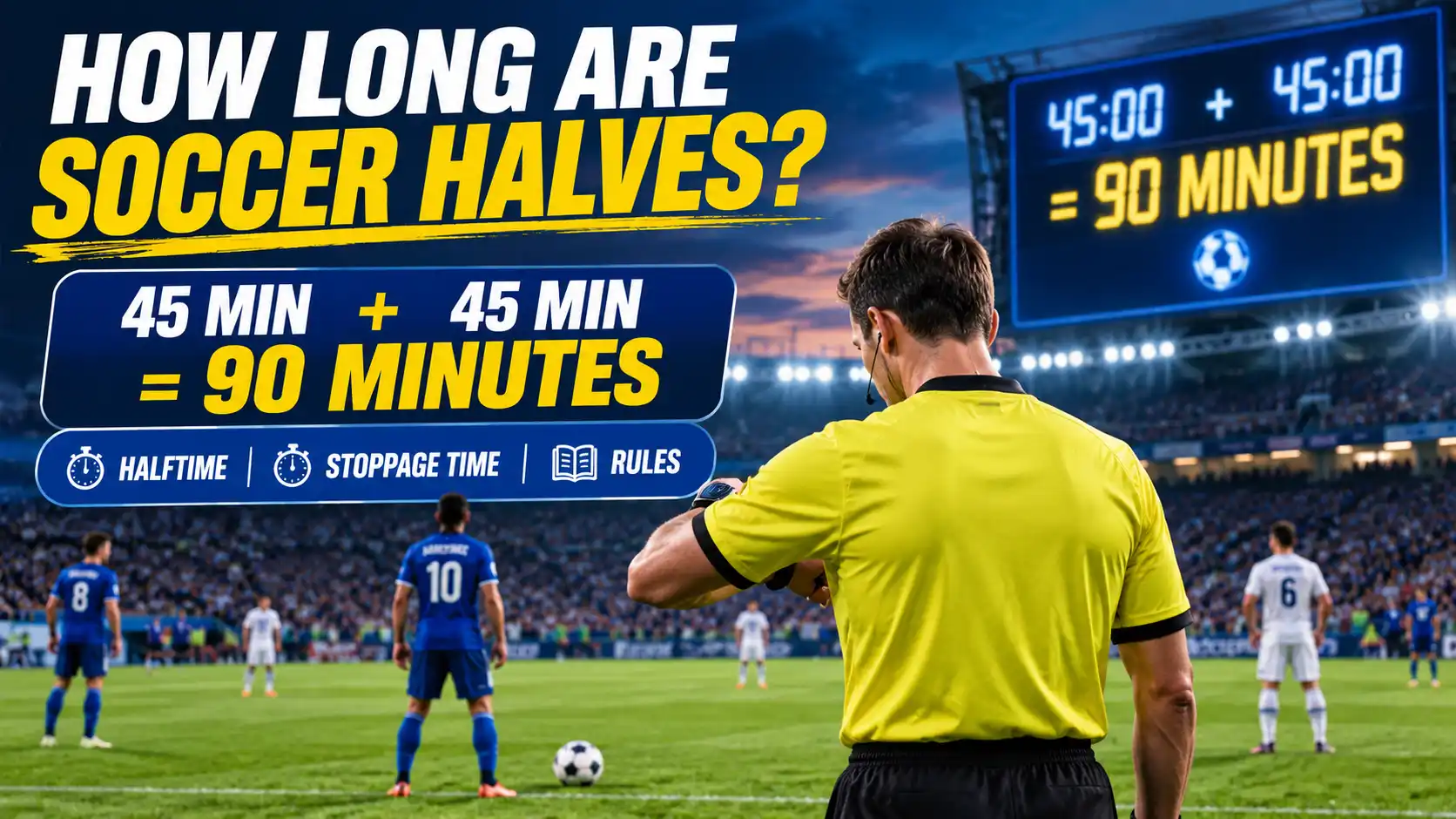
A standard soccer match has two 45-minute halves, giving players 90 minutes of regulation playing time. However, the actual time from kickoff to the final whistle is usually longer because of halftime and stoppage time.
The exact match length can also change depending on the competition and age group. Professional soccer, college soccer, high school soccer, and youth soccer can all follow slightly different timing rules.
If you’re learning the rules of the game, a soccer goalie coach in Connecticut can also help players and goalkeepers better understand different parts of soccer.
How Long Is a Soccer Half?
A standard soccer half lasts 45 minutes.
A full regulation match therefore has:
- First half: 45 minutes
- Second half: 45 minutes
- Regulation playing time: 90 minutes
- Standard halftime: 15 minutes
This 90-minute format is used in professional soccer competitions around the world, including major domestic leagues and international tournaments.
The International Football Association Board (IFAB) sets the Laws of the Game used in association football. Under the standard rules, a match consists of two equal halves of 45 minutes.
So, when someone asks, “How long is a soccer match?” the basic answer is 90 minutes of regulation play.
However, the complete experience usually takes longer than 90 minutes because the match also includes stoppage time and a halftime break.
Why Does a Soccer Match Last 90 Minutes?
The 90-minute match format has been used in organized soccer for more than a century.
The length gives players enough time to develop attacks, defend, adjust tactics, and respond to changes during the match. It also creates a consistent structure for competitions at the professional level.
Each half gives both teams the same amount of playing time. The break between them gives players an opportunity to recover while coaches make tactical changes.
The result is a match format that has become the standard for professional and international soccer.
How Long Is Halftime in Soccer?
A standard halftime break lasts 15 minutes.
During halftime, players usually leave the field while coaches and staff review the first half. Players may:
- Drink water and rehydrate
- Receive treatment for minor injuries
- Discuss tactics with coaches
- Change their formation or approach
- Prepare for the second half
The Laws of the Game state that the halftime interval must not exceed 15 minutes.
Youth and recreational competitions may use shorter halftime periods. Depending on the age group and league rules, the break may be around 5 to 10 minutes.
What Is Stoppage Time in Soccer?
Stoppage time in soccer is the extra time added to the end of each half to make up for time lost during the match. The game clock usually keeps running when play is interrupted, so the referee adds time back after the 45th minute of the first half and the 90th minute of the second half.
Stoppage time can be added for delays such as:
- Player injuries and medical treatment
- Substitutions
- Goal celebrations
- VAR checks and reviews
- Disciplinary procedures
- Time-wasting
- Other significant interruptions
For example, if the referee announces +5 minutes at the end of the second half, the match will continue for at least five additional minutes. The referee can add more time if another significant delay occurs during stoppage time.
You may also hear added time or injury time used to describe stoppage time. These terms generally refer to the same additional playing time.
The amount of stoppage time is not fixed. It depends on how much time was lost during that particular half, so one match may have a few minutes while another may have considerably more.
For goalkeepers and players, understanding stoppages is also part of understanding how the game is managed. You can learn more about the rules that apply specifically to goalkeepers in our guide to soccer goalie rules.
How Do Referees Calculate Stoppage Time?
Stoppage time is based on time lost during the half. The referee and other match officials keep track of delays and determine the minimum amount of additional time to be played.
The fourth official normally displays the announced amount of added time on the electronic board near the end of the half.
For example, if the board shows +5 minutes, the referee has indicated that at least five additional minutes will be played.
The match can continue beyond that minimum if another significant delay occurs during stoppage time.
This is why a match scheduled to last 90 minutes can take noticeably longer before the final whistle.
How Long Does a Full Soccer Match Take?
A standard soccer match has 90 minutes of regulation playing time, but spectators should usually plan for more than 90 minutes.
A typical professional match includes:
45 minutes
First half
15 minutes
Halftime
45 minutes
Second half
Additional time
Stoppage time at the end of each half
That means the actual time from kickoff to the final whistle is often around two hours, depending on the amount of stoppage time.
If the match requires extra time, the total duration can become significantly longer.
What Is Extra Time in Soccer?
Extra time is additional playing time used in certain knockout matches when a winner must be determined.
If the score is tied after 90 minutes of regulation play and the competition rules require a winner, the match can go into extra time.
Standard extra time consists of:
- First extra-time period: 15 minutes
- Second extra-time period: 15 minutes
- Total extra time: 30 minutes
The teams play both periods even if one side scores during the first extra-time period.
Extra time is mainly used in knockout competitions where one team must advance to the next round.
Regular league matches generally do not use extra time. If a league match finishes level after regulation and stoppage time, the match ends as a draw.
What Happens After Extra Time?
If the score remains tied after extra time and the competition requires a winner, the match can proceed to a penalty shootout.
Penalty shootouts are used to determine which team advances.
Each team initially takes five penalty kicks, with the teams alternating attempts.
If one team has more successful penalties after five kicks each, that team wins the shootout.
If the teams are still tied, the shootout continues with additional rounds. Each side takes one kick per round until one team scores and the other does not in the same round.
Penalty situations are especially important for goalkeepers because they can decide the outcome of a knockout match. For more detail, see our guide to penalty kick rules in soccer.
How Long Is a Penalty Shootout?
There is no fixed number of minutes for a penalty shootout.
Its length depends on how quickly the kicks are taken and whether the teams remain tied.
A shootout can finish after the initial five kicks per team, or it can continue into additional rounds.
The shootout does not add another timed period to the match. Instead, penalty kicks are used to determine the winner.
Soccer Match Length by Competition
Match timing can vary depending on the level of soccer being played.
| Competition | Half Length | Halftime | Regulation Time | Extra Time |
| FIFA international competitions | 45 minutes | 15 minutes | 90 minutes | Used in applicable knockout matches |
| Premier League | 45 minutes | 15 minutes | 90 minutes | Not used in regular league matches |
| MLS | 45 minutes | 15 minutes | 90 minutes | Used in applicable playoff matches |
| NCAA Soccer | 45 minutes | 15 minutes | 90 minutes | Postseason rules may apply |
| NFHS High School Soccer | 40 minutes | Varies | 80 minutes | Depends on state and competition |
| Youth Soccer | Age-dependent | Usually 5–10 minutes | Age-dependent | Depends on competition |
Always check the rules of the specific competition because match timing can differ between leagues, tournaments, states, and age groups.
How Long Are College Soccer Halves?
NCAA soccer uses two 45-minute halves, giving a regulation match 90 minutes of playing time.
Regular-season college matches can finish as a draw when the score remains level after regulation.
Postseason matches have different requirements because a winner may need to be determined.
Competition rules should be checked for the specific tournament or postseason stage.
How Long Are High School Soccer Halves?
High school soccer generally uses two 40-minute halves, giving the match 80 minutes of regulation playing time.
However, high school soccer rules can vary by state association and competition.
Overtime procedures can also differ, so players, parents, and coaches should check the rules used by their local athletic association.
How Long Are Youth Soccer Halves?
Youth soccer does not use one universal match length.
The length usually depends on the players’ age and the rules of the league or competition.
Younger players may have shorter playing periods, while older youth teams may play longer matches.
Some youth formats also divide the game into quarters rather than two traditional halves. This allows younger players to receive more regular breaks and helps manage playing time.
A youth soccer match might therefore look very different from a professional 90-minute match.
Why Doesn’t the Soccer Clock Stop?
In soccer, the match clock normally continues running during most interruptions.
Instead of stopping the clock every time play is interrupted, the referee accounts for significant lost time by adding stoppage time to the end of the half.
This keeps the match moving while still allowing officials to account for delays.
Common causes of lost time include:
- Injuries and medical treatment
- Player substitutions
- Goal celebrations
- Disciplinary procedures
- VAR reviews
- Deliberate delays
- Other significant interruptions
This is one reason the time shown on the stadium clock may reach 45 or 90 minutes before the match actually ends.
From Kickoff to Full Time: How a Soccer Match Works
A standard soccer match follows a simple sequence.
1. Kickoff
The referee starts the match with a kickoff from the center mark.
2. First Half
The teams play for 45 minutes, plus any stoppage time added by the referee.
3. Halftime
Players leave the field for a break of up to 15 minutes in a standard match.
4. Second Half
The teams return to the field and play another 45 minutes, followed by any applicable stoppage time.
5. Full Time
The referee ends the match with the final whistle.
If the competition allows a draw, the match ends there.
If the competition requires a winner, extra time or a penalty shootout may follow according to the competition rules.
The final score also determines the result of the match. In league soccer, that result affects the points awarded to each team. If you want to understand how scoring relates to the final result, see our guide on how many points a goal is worth in soccer.
Can a Soccer Match Last More Than Two Hours?
Yes. A normal 90-minute match with a 15-minute halftime break often takes close to two hours from kickoff to the final whistle.
The match can last longer when there is a large amount of stoppage time.
Knockout matches can take even longer if extra time is required. Adding two 15-minute extra-time periods creates another 30 minutes of playing time, plus any stoppage time during those periods.
If the match is still tied, a penalty shootout follows.
So a knockout match can last well beyond two hours before a winner is decided.
Does Every Soccer Match Have Extra Time?
No. Extra time is not part of every soccer match.
Most regular league matches end after 90 minutes plus stoppage time. If the score is tied, the match is recorded as a draw.
Extra time is generally used when a competition requires one team to advance and the score is still level after regulation.
The exact rules depend on the competition.
Frequently Asked Questions
How long is a soccer half?
A standard soccer half lasts 45 minutes. Two halves make 90 minutes of regulation playing time.
How long is halftime in soccer?
Standard halftime lasts up to 15 minutes. Youth and other competitions may use shorter breaks.
What is stoppage time in soccer?
Stoppage time is additional time played at the end of a half to account for significant delays during the match.
How does extra time work in soccer?
When a knockout competition requires a winner and the match is tied after regulation, teams can play two 15-minute extra-time periods.
What happens if a soccer match is still tied after extra time?
If the competition requires a winner, the match can go to a penalty shootout. Each team initially takes five penalty kicks.
How long are youth soccer halves?
Youth soccer timing depends on the age group and league. Younger players generally play shorter periods than older youth players.
The Bottom Line
A standard soccer match has two 45-minute halves, with a 15-minute halftime break and added stoppage time. Most matches take around two hours from kickoff to final whistle.
If a knockout match is tied after 90 minutes, it may go into two 15-minute extra-time periods, followed by a penalty shootout if needed.