Take a close look at a full-size soccer goal, and it may not seem enormous until you’re the goalkeeper standing in front of it.
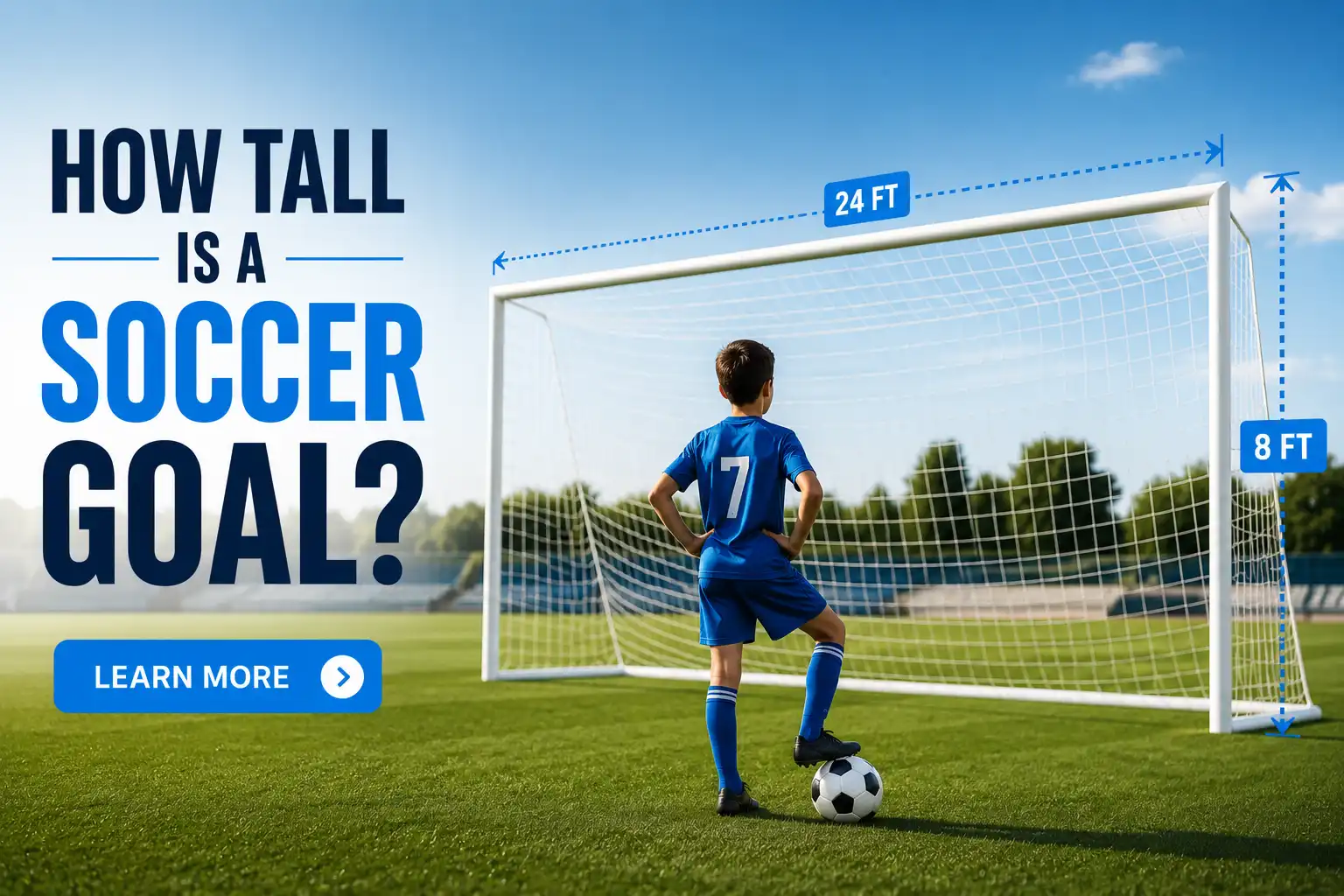
From one post to the other, there are 24 feet of space to protect. The crossbar sits 8 feet above the ground, and a goalkeeper has only seconds to react when the ball comes flying toward the net.
A regulation adult goal is 8 feet tall and 24 feet wide. In metric measurements, that’s 2.44 metres high and 7.32 metres wide.
However, not every league or age group uses the same goal. Youth soccer, futsal, beach soccer, and small-sided games often use smaller goals. Let’s look at the official soccer goal dimensions and explain what they mean for players and goalkeepers.
What Is the Official FIFA Soccer Goal Size?
The standard FIFA soccer goal size used for full-size 11v11 matches is:
- Height: 8 feet or 2.44 metres
- Width: 24 feet or 7.32 metres
- Distance between the posts: 8 yards
Technically, these measurements come from the IFAB Laws of the Game, which govern international soccer.
A regulation goal contains two upright posts joined by a horizontal crossbar. The goal must stand in the centre of the goal line, with each post the same distance from the nearest corner flag.
The posts and crossbar must be white and made from an approved material. They can be square, rectangular, round, elliptical, or a combination of approved shapes, provided they aren’t dangerous.
The goal must also be securely anchored. This is especially important for portable goals, which can tip over if they aren’t properly installed.
How Wide Is a Soccer Goal?
If you’re wondering how wide a soccer goal is, the answer is 24 feet, 8 yards, or 7.32 metres.
The width is measured from the inside edge of one post to the inside edge of the other. Measuring from the outside of the posts is a common mistake and produces an incorrect result.
To picture the size, imagine two average family cars parked end to end. That’s roughly the width a goalkeeper must defend.
No goalkeeper can cover all 24 feet while standing still, not even professionals such as Thibaut Courtois or Alisson Becker. They rely on positioning, footwork, timing, and anticipation to reduce the area an attacker can aim for.
That’s why learning proper goalkeeper catching techniques is only one part of the job. A goalkeeper must first get into the right position to reach the shot.
What Is the Regulation Soccer Goal Height and Width?
The official regulation soccer goal height and width is 8 feet by 24 feet.
This full-size goal is generally used in:
- Professional soccer
- FIFA international matches
- Adult amateur competitions
- NCAA college soccer
- Many high-school competitions
- Older youth 11v11 matches
The same dimensions are used at both ends of the field. Unlike the field itself, which can vary within permitted ranges, the full-size goal has fixed measurements.
This consistency allows players to train for the same target they’ll face during competitive matches.
However, knowing how tall a soccer goal is doesn’t automatically tell you how to defend it. Professional goalkeepers don’t simply wait on the goal line. They move forward to narrow the angle and make the visible target smaller.
A famous example came in the closing moments of the 2022 FIFA World Cup final. Argentina goalkeeper Emiliano Martínez rushed toward France’s Randal Kolo Muani and blocked what looked like a certain goal. He couldn’t physically cover the entire net, so he used positioning to reduce the attacker’s options.
How Is Soccer Goal Height Measured?
The height of a goal is measured vertically from the ground to the lower edge of the crossbar.
To measure a goal properly:
- Place the measuring tape on level ground beneath the crossbar.
- Measure vertically to the bottom of the crossbar.
- Repeat the measurement in another place to check for uneven ground.
- Measure the width between the inside edges of the two posts.
- Confirm that the goal is securely anchored before it is used.
The thickness of the posts isn’t added to the 24-foot width. That measurement only covers the open space between them.
If the playing surface is uneven, it may affect the height. That’s why goals and fields should be checked before a match begins.
Are Youth Soccer Goals the Same Size as Adult Goals?
No. Most young players use smaller goals that match their age, physical development, and game format.
Common youth soccer goal sizes include:
| Age group | Common goal-size range |
| Ages 4–5 | 4–5 feet high by 6–10 feet wide |
| Ages 6–7 | 5–6 feet high by 9–12 feet wide |
| Ages 8–11 | 6–7 feet high by 18–21 feet wide |
| Ages 12+ | Up to 8 feet high by 24 feet wide |
These sizes are general guidelines. Individual leagues and soccer organisations may use different measurements, especially for 4v4, 7v7, and 9v9 matches.
Parents and coaches should therefore check the competition’s rules before purchasing or setting up a goal.
Putting a seven-year-old goalkeeper in a full-size net would be like asking them to guard a garage door. They may use perfect technique and still have no realistic chance of reaching a high shot.
Smaller goals make the game fairer and help young goalkeepers build confidence.
At What Age Do Players Start Using a Full-Size Goal?
Many players move to the full soccer goal size at around age 12 or when they begin playing 11v11 soccer.
However, there’s no single age used by every league. The transition depends on:
- Competition rules
- Match format
- Player development
- Field availability
- Local soccer-association guidance
Moving to a full-size goal can be challenging. A goalkeeper who felt comfortable in a smaller net may suddenly see open space above and beside them.
This is where individual coaching can help. The benefits of a private goalie coach include personalised work on angles, movement, diving, and confidence during the transition.
Why Does Goal Size Matter for Goalkeepers?
A full-size goal covers an opening of 192 square feet. That’s a lot of space for one person to protect.
Understanding how tall is a soccer goal helps explain why goalkeepers need more than quick reactions.
Positioning
A goalkeeper’s position determines how much of the goal an attacker can see. Standing too close to one post leaves the opposite side open, while staying on the goal line gives the attacker a larger target.
Angles
Moving forward at the right time makes the goal appear smaller. During a one-on-one situation, even a few steps can reduce the attacker’s options.
Footwork
Goalkeepers usually take several adjustment steps before diving. Good footwork helps them reach both sides of the goal without losing balance.
Jumping and reach
With the crossbar 8 feet above the ground, goalkeepers must learn how to jump, extend their arms, and time high saves.
Catching and handling
Reaching the ball is only half the battle. A goalkeeper must catch it securely or direct it away from danger.
Clean, well-maintained gloves can support handling. If your palms are losing grip, learn how to make goalkeeper gloves sticky again.
What Size Is a Futsal Goal?
A futsal goal is much smaller than a standard outdoor goal. It measures:
- 2 metres or approximately 6.5 feet high
- 3 metres or approximately 9.8 feet wide
Futsal is played on a smaller court with fewer players. Shots often come from close range, so the reduced soccer goal dimensions help balance the game.
The smaller goal doesn’t necessarily make goalkeeping easy. The pace is fast, reaction times are short, and the goalkeeper frequently uses their feet as well as their hands.
What Size Is a Beach Soccer Goal?
A beach soccer goal is smaller than a regulation 11v11 goal. It is approximately:
- 7.2 feet high
- 18 feet wide
Diving and moving on sand are more difficult than moving on grass or artificial turf. The smaller goal gives the goalkeeper a more realistic area to defend.
This is another example of how the correct soccer goal size depends on the playing surface and version of the sport.
Are Training Goals Regulation Size?
Training goals come in many sizes. Coaches may use portable or mini goals for:
- Passing exercises
- Finishing practice
- Small-sided matches
- Accuracy drills
- Quick decision-making
- Goalkeeper footwork
Smaller goals encourage shooters to aim carefully. They can also help goalkeepers practise positioning without being overwhelmed by a full-size net.
However, goalkeepers eventually need experience in a regulation goal. Training only with small goals won’t fully prepare them for high shots, crosses, or the angles found in an 8-by-24-foot goal.
A qualified goalkeeper coach can combine different goal sizes to develop technique before moving into realistic match situations.
Soccer Goal Safety
Correct measurements matter, but safety matters even more.
Portable goals must always be anchored according to the manufacturer’s instructions. Children should never climb or hang from the crossbar, and damaged frames or nets should be repaired before play begins.
Before using a goal, check that:
- It is securely anchored
- The frame isn’t bent or cracked
- The net is properly attached
- There are no sharp edges
- The area around the goal is clear
- The crossbar and posts are stable
As the saying goes, it’s better to be safe than sorry.
Frequently Asked Questions
How tall is a soccer goal?
A full-size soccer goal is 8 feet or 2.44 metres tall, measured from the ground to the lower edge of the crossbar.
How wide is a soccer goal?
A regulation goal is 24 feet, 8 yards, or 7.32 metres wide. The measurement is taken between the inside edges of the posts.
What are the official FIFA soccer goal dimensions?
The official FIFA soccer goal size for full 11v11 soccer is 8 feet high by 24 feet wide.
Do all countries and leagues use the same goal size?
Full-size 11v11 competitions generally use the same regulation dimensions. Youth, futsal, beach soccer, and small-sided leagues may use smaller goals.
Why does goal size matter for goalkeepers?
Goal size affects positioning, footwork, angles, jumping, and diving. A goalkeeper must learn to reduce the available target rather than trying to cover the entire goal from the line.
At what age do players use a full-size goal?
Many players move to full-size goals at around age 12, but the exact age depends on their league and playing format.
Final Thoughts
Youth players generally begin with smaller goals and move to full-size dimensions as they develop. That gradual change gives young goalkeepers time to improve their movement, confidence, and understanding of angles.
No goalkeeper can stand still and cover every inch of a 24-foot goal. The best goalkeepers make the target feel smaller through smart positioning and good technique. With the right training, that huge frame becomes much less intimidating.