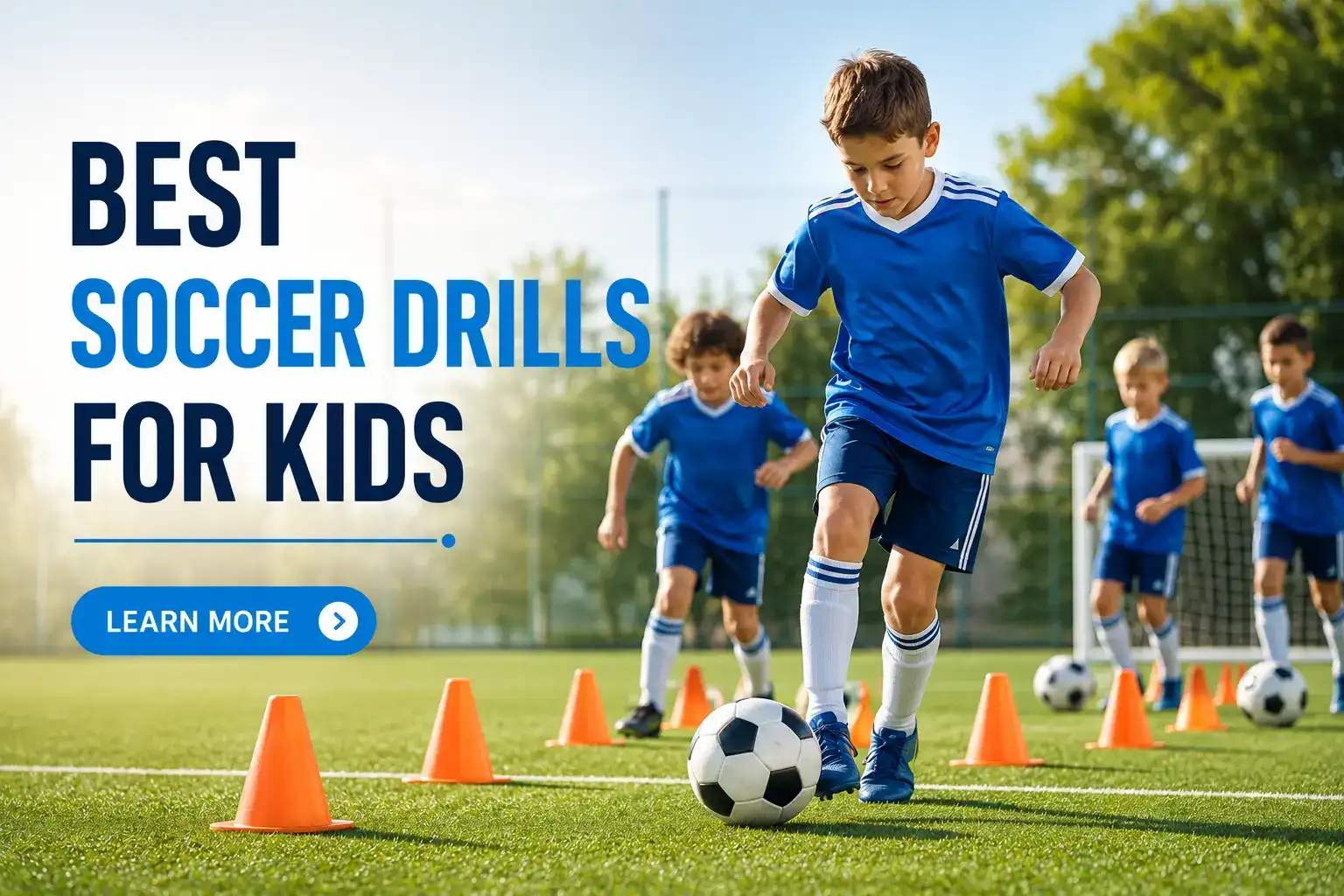
Kids learn soccer best when they’re moving, touching the ball, and having fun.
Long lines and long talks can make young players lose interest. The best youth soccer drills feel more like games. Kids stay active while learning how to dribble, pass, shoot, and work with teammates.
You don’t need fancy equipment. A few cones, some soccer balls, and a safe space are enough for most soccer drills for kids.
Here are ten fun drills that coaches and parents can use.
Why Are Youth Soccer Drills Important?
The main benefits of youth soccer drills go beyond learning how to kick a ball.
Good drills can help children improve:
- Balance and movement
- Ball control
- Passing and shooting
- Speed and fitness
- Teamwork
- Focus
- Confidence
Children also learn how to make quick choices. They begin to understand when to pass, when to dribble, and where to move.
The best drills give every child many touches on the ball. They also match the child’s age and skill level.
1. Red Light, Green Light
This is one of the easiest beginner soccer drills for young children.
Give each player a ball and place them behind a starting line. The coach stands about 15 to 20 yards away.
When the coach says “green light,” players dribble forward. When the coach says “red light,” everyone must stop the ball.
Add a “yellow light” and ask players to dribble slowly.
This game teaches children to:
- Keep the ball close
- Change speed
- Stop under control
- Listen while moving
Remind players to take small touches. If they kick the ball too far ahead, they may lose control.
For an extra challenge, ask them to use only their weaker foot.
2. Gates Dribbling
Make several small gates using pairs of cones. Spread the gates around the field.
Each child gets a ball. Players must dribble through as many gates as possible in one minute.
They should look up, find an open gate, and avoid other players.
This is one of the best youth soccer training drills for dribbling and awareness. Children learn that they can’t stare at the ball all the time.
Try these simple changes:
- Use only the right foot
- Use only the left foot
- Perform a turn after each gate
- Give one point for every gate
- Ask players to beat their previous score
Keep the gates wide for beginners. Make them smaller as players improve.
3. Ball Mastery Box
Create a square with four cones. Each player stands inside the square with a ball.
Call out simple moves, such as:
- Toe taps
- Inside-foot touches
- Outside-foot touches
- Sole rolls
- Pullbacks
- Stepovers
Start slowly. Good control matters more than speed.
Keep each round short—about 20 to 30 seconds. Let players rest before starting a new move.
This is one of the easiest soccer exercises for kids to practise at home. A child only needs a ball and a small safe area.
Encourage players to use both feet. It may feel awkward at first, but that’s how the weaker foot gets stronger.
4. Knockout
Mark a square and give every player a ball.
Players dribble inside the area while trying to protect their own ball. At the same time, they try to gently kick other players’ balls outside the square.
If a ball goes out, the player can do five toe taps and return to the game. This keeps everyone involved.
Knockout teaches:
- Close ball control
- Safe tackling
- Shielding
- Awareness
- Quick turns
Make sure children understand that they should play the ball, not kick another player’s feet.
Use a larger square for beginners. Use a smaller space when players are ready for more pressure.
5. Passing Through Gates
Place pairs of cones around the field to create gates. Put players into pairs and give each pair one ball.
Partners pass the ball through a gate, then move to a different one. They score one point for every successful pass.
This is one of the most useful Youth Soccer Drills for passing and receiving.
Teach players to:
- Place the non-kicking foot beside the ball
- Use the inside of the foot
- Pass with the right amount of power
- Receive the ball with a soft first touch
- Move after passing
Ask players to count how many gates they complete in one minute. Then let them try to beat their score.
For older children, add a rule that they can’t use the same gate twice in a row.
6. Passing Triangle
Place three cones in a triangle. Put one player at each cone.
The first player passes to the next player and follows the ball to that cone. The second player receives, passes to the third player, and follows their pass.
The pattern continues around the triangle.
This drill helps children learn:
- Passing accuracy
- First touch
- Movement after passing
- Body position
- Communication
Beginners can take two or three touches. More skilled players can try two-touch or one-touch passing.
Don’t rush children into one-touch play. A clean pass after two touches is better than a rushed pass that misses the target.
7. Sharks and Minnows
Choose one or two players to be the sharks. Everyone else is a minnow with a ball.
The minnows try to dribble from one side of the field to the other. The sharks try to win their balls.
A minnow who loses the ball can become a shark in the next round.
This is one of the most popular soccer drills for kids because it feels like a playground game.
It teaches dribbling, turning, shielding, and decision-making. Children learn to find open space instead of following the crowd.
Tell players to keep their heads up and change direction when a shark gets close.
8. Numbers Shooting Game
Divide the players into two teams. Give each child on both teams a number.
Place the teams on opposite sides of the coach. Put one ball in the middle.
When the coach calls a number, the player with that number from each team runs toward the ball. They compete to win it and score.
This game works on:
- Reaction speed
- Shooting
- One-on-one play
- Defending
- Confidence
Call two numbers at once to create a 2v2 game. This adds passing and teamwork.
Goalkeepers can also join the drill. Before shooting begins, they can complete simple goalkeeper warm-up drills to prepare their hands and feet.
9. Small-Sided Soccer
Set up a small field and play 3v3 or 4v4. Use mini goals if possible.
Small-sided games are among the best youth soccer drills because every player gets more time with the ball.
Children learn:
- How to find space
- When to pass
- How to support teammates
- How to defend
- How to move without the ball
Avoid stopping the game every few seconds. Let children solve simple problems on their own.
Coaches can add one easy rule. For example, a team must complete three passes before scoring. You can also award an extra point for a weaker-foot goal.
Keep teams small. When too many children share one ball, some players may hardly touch it.
10. Goalkeeper Footwork and Diving
Goalkeepers need activities made for their position.
Place three cones in a line. The goalkeeper moves quickly between them using small side steps. After the last cone, the coach rolls or gently throws the ball for the goalkeeper to collect.
Focus on:
- Staying balanced
- Keeping the knees slightly bent
- Moving without crossing the feet
- Getting the body behind the ball
- Holding the ball safely
Players can build quicker movement with these goalkeeper footwork drills.
Diving should be taught slowly and on a safe surface. Young goalkeepers should first learn how to land without hurting their elbows, hips, or shoulders.
These goalkeeper diving drills explain how to develop the skill step by step.
How to Choose Drills by Age
Not every drill works for every age.
Ages 4–6
Keep activities simple and playful. Use stories, colours, animals, and fun names.
Good options include:
- Red Light, Green Light
- Sharks and Minnows
- Basic ball touches
- Dribbling races
Keep each activity short. Young children may be ready for a new game after five or six minutes.
Ages 7–9
Players can follow more rules and work with partners.
Try:
- Gates Dribbling
- Passing Through Gates
- Knockout
- Simple shooting games
- 2v2 or 3v3 matches
Continue giving each child plenty of time with the ball.
Ages 10–12
Older children can handle more pressure and teamwork.
Try:
- Passing triangles
- One-on-one games
- Rondos
- 3v3 or 4v4 possession games
- Shooting from different angles
These players should still have fun, but the drills can include more choices and challenges.
How Long Should Kids Practise?
Young players don’t need hours of training every day.
A short, focused session is often better than a long session where children become tired or bored.
A simple schedule might include:
- Ages 4–6: 20 to 30 minutes
- Ages 7–9: 30 to 45 minutes
- Ages 10–12: 45 to 60 minutes
One to three practice sessions per week may be enough for many children. The right amount depends on the child’s age, interest, health, and team schedule.
Rest matters too. Kids need time to recover, play freely, and enjoy other activities.
How Can Coaches Make Drills Fun?
Fun doesn’t mean players aren’t learning. Children often learn more when they’re excited and involved.
Coaches can make Youth Soccer Drills enjoyable by:
- Giving drills fun names
- Using short rounds
- Keeping lines small
- Letting every child touch the ball
- Praising effort
- Adding simple challenges
- Changing the game before it becomes boring
Don’t give a five-minute speech before a drill. Show the activity quickly, check that everyone understands, and let them play.
Correct one or two things at a time. Too many instructions can make children nervous or confused.
A skilled goalkeeper coach can also make position-based training safe, active, and suitable for the player’s age.
Frequently Asked Questions
What are the best youth soccer drills for beginners?
Red Light, Green Light, Gates Dribbling, Ball Mastery Box, and Passing Through Gates are great for beginners. They’re simple, fun, and give children many touches on the ball.
Which drills help kids improve dribbling?
Gates Dribbling, Sharks and Minnows, Knockout, and Red Light, Green Light all teach close control and changes of direction.
What are the best passing drills for young players?
Passing Through Gates and Passing Triangles teach accuracy, first touch, communication, and movement after a pass.
How do drills improve a child’s ball control?
Good drills give children many chances to touch the ball with both feet. Over time, these repeated touches move feel smoother and more natural.
How often should youth players practise?
Many children can practise one to three times each week. Sessions should match their age and leave enough time for rest.
Can kids practise soccer drills at home?
Yes. Toe taps, sole rolls, wall passes, cone dribbling, and target shooting can all be practised in a safe space at home.
Final Thoughts
The best Youth Soccer Drills don’t need to be complicated. They keep children moving, give them many touches, and teach skills through play.
Start with simple beginner soccer drills. Add more pressure and teamwork as children improve. Most importantly, keep the experience positive.
When kids enjoy practice, they want to return. And when they keep returning, their skills, confidence, and love for soccer can grow together.